Ramekin is thought to come from a Dutch word for "toast" or the German for "little cream."


Name

Ramekin

Variant

Ramequin, Ramekin dish.

Pronounced

(ram′ə kin)[RAM-ih-kihn]ræməkin

Function

English Noun

Plural

Ramekins

Hypernym

A type of dish

Purpose

Cooking

Etymology

French Ramequin from Low German ramken, diminutive of cream, circa 1706. middle Dutch rammeken (cheese dish) dialect variant of rom (cream), similar to old English ream and German rahm. Ancient French cookbooks refer to ramekins as being garnished fried bread.


Meaning

1. A food mixture, (casserole) specifically a preparation of cheese, especially with breadcrumbs and/or eggs or unsweetened pastry baked on a mould or shell.

2. With a typical volume of 50-250 ml (2-8 oz), it is a small fireproof glass or earthenware individual dish similar in size and shape to a cup, or mould used for cooking or baking and serving sweet or savoury foods.

3. Formerly the name given to toasted cheese; now tarts filled with cream cheese.

4. A young child usually between the ages of 3 months and 11 years exhibiting a compulsion to force or "ram" their head into various objects and structures.

These days, a ramekin is generally regarded as a small single serve heatproof serving bowl used in the preparation or serving of various food dishes, designed to be put into hot ovens and to withstand high temperatures. They were originally made of ceramics but have also been made of glass or porcelain, commonly in a round shape with an angled exterior ridged surface. Ramekins have more lately been standardized to a size with a typical volume of 50-250 ml (2-8 ounce) and are now used for serving a variety of sweet and savoury foods, both entrée and desert.

They are also an attractive addition to the table for serving nuts,dips and other snacks. Because they are designed to hold a serving for just one person, they are usually sold in sets of four, six, or eight. Ramekins now are solid white, round, with a fluted texture covering the outside, and a small lip. Please bear in mind that whatever you ask for them on Internet auction sites, someone is still getting the same thing in an op shop for peanuts.

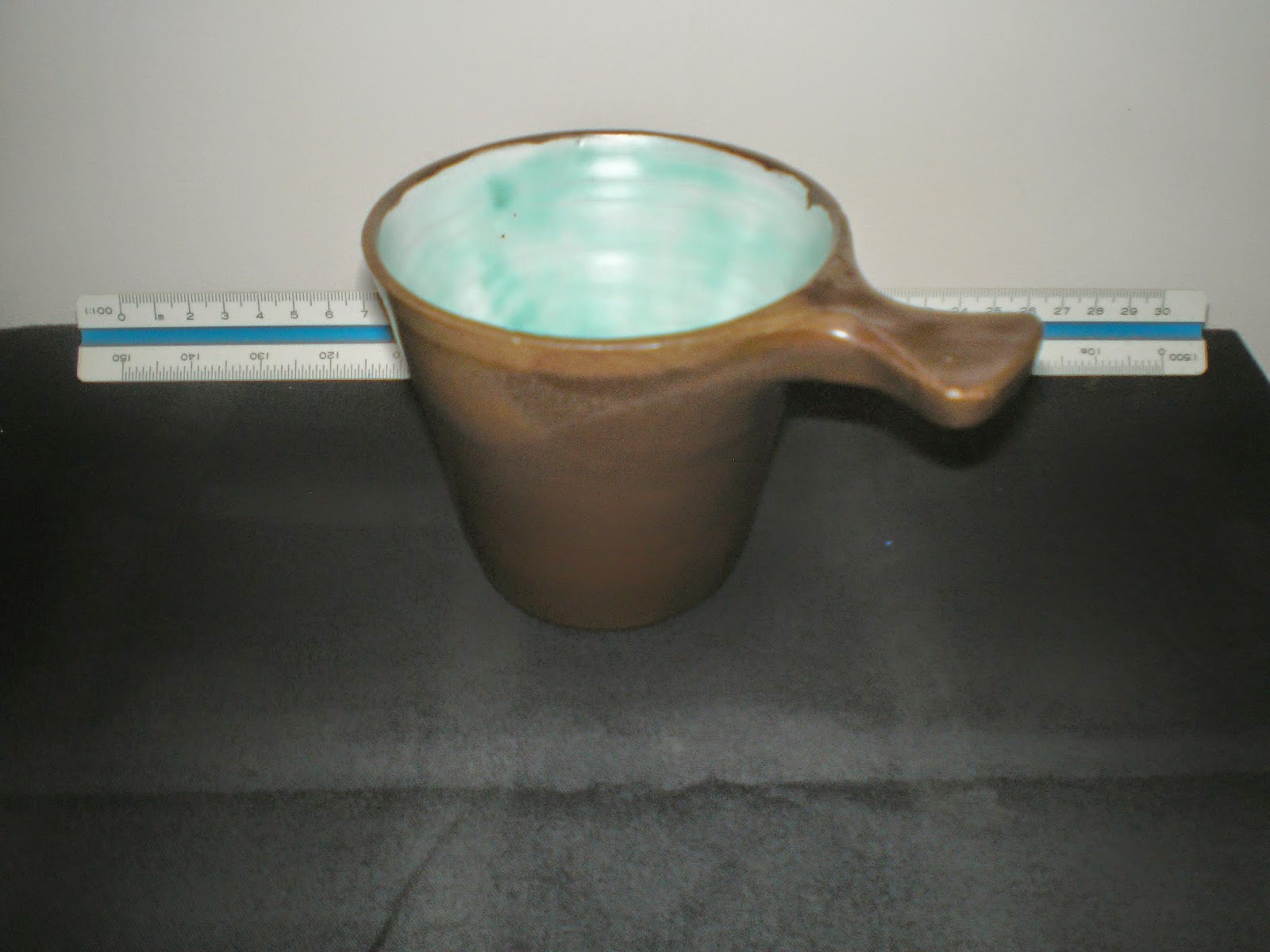
However, there are hundreds of decorative ramekins that came in a variety of shapes and sizes. They came in countless colours and finishes and many were made by our leading artists and ceramicists. My collection has ramekins with One handle only, fixed to the body at one point only. If it has no handle, it is a bowl. If it has two, it is a casserole dish. But the glory day of the Australian Studio Art ramekin is well and truly over. See some here, ask questions or leave answers.

P.S. Remember, just as real men don't eat quiche, real ramekins don't have lids or two handles. Also remember, two handles makes it a casserole dish. Also, please note If it aint got a handle, it's just a bowl.

P.P.S. To all you cretins who advertise your ramekins by associating them with "Eames" or "Eames Era". Get your hand off it, you are not kidding anyone. The Eames people have told me that they never made ramekins.

P.P.P.s To all the illiterates out there in cyberspace, just as there is no "I" in team, there is no "G" in Ramekin. I am the Rameking, they are ramekins.

If you have a set of Grandma's ramekins at the back of a kitchen cupboard, have a look through the site, maybe you will identify them. Thank-you for looking.

There are many of you out there that have knowledge of Australian pottery. Please let me know if you have anything that I can add to the notes. It is important to get the information recorded. You probably know something that nobody else does.

Please note that while your comments are most welcome, any that contain a link to another site will no longer be published.

-


Monday, November 3, 2014

Tienshan


Designer        

Maker
Tienshan (Shandong Silver Phoenix Co Ltd)
Marks
No marks
Material
Earthenware slip
Description
Large bowl with a waisted top and knob handle with hole to underside.  Unglazed foot ring.  Matte white glaze to entire body.  Transfer print on side of bowl.
Condition
Very good
Number
No number
Production Date
1980s
Width at rim
120mm
Width at Base
105mm
Depth
70mm
Length (with handle)
210mm
Weight
325gm
Volume
750mm
Acquisition
Purchase
Salvo Stores
Rameking Reference Number
TSH 001-004

Go tell Aunt Rhody
Go tell Aunt Rhody
Go tell Aunt Rhody
The Old Grey Goose Is Dead.

This pattern comes from the Tienshan “Aunt Rhody” collection.  The pattern is “Country Goose” and features a blue goose with a polka dot bow tie.

Tien Shan, is a large mountain range located in Central Asia.  Tienshan pottery is made by Tienshan Incorporated who is not, as the name implies, a Chinese company.  It began in Norwalk Connecticutt, USA in 1978.  Their headquarters is at Suite 1 231 Wilson Street.  They also have an office at 41 Madison Avenue, mid-town New York.  Sakura Incorporated, another porcelain company also operates at the address.  They manufacture stoneware and porcelain dinnerware in China and export overseas. 


I think that they get the Shandong Silver Phoenix Company Limited to actually make their pottery.  This prize winning, top ten ceramics company has over 3,000 employees and is located at 58 Jinqueshan Road, Linyi, Shandong, China.  The company was established in 1957 and produces 1000 lines of high volume (120 million items per annum) porcelain, stoneware and genuine bone china.  They make hotel ware as well as tea and coffee sets.  They export to sixty countries and produce goods for a number of other makers including Churchill in the UK.


Monday, October 27, 2014

Robert Gordon Pottery


Designer        
Homage to June Dyson ramekin from 1960s
Maker
Robert Gordon
Marks
Stamped “Cutie Pies Robert Gordon Australia made in china” in black ink to base.
Material
Glazed slip
Description
Gloss glazed slip in pale pastel colours.  Mould formed with flat handle moulded to top of rim, splayed at end.  Unglazed foot ring.
Condition
Very good
Number
No number
Production Date
1990s
Width at rim
110mm
Width at Base
65mm
Depth
65mm
Length (with handle)
140mm
Weight
280gm
Volume
300ml
Acquisition
Purchase
Waverly Antiques
24 October 2014
Rameking Reference Number
RGP 001 to 004

Just like mother used to make.  That is what you could say about these ramekins.  Similar in design to earlier June Dyson ramekins.  The “Cutie Pies” range is no longer made, but these examples survive.  These ramekins are stamped “made in china” as part of the base.  The full stamp says “Cutie Pies Robert Gordon Australia made in china”.  Earlier works made in Gembrook at the Pack Track Pottery are hand painted with “Robert Gordon” or just, “Gordon” in oxide. Wares made at the Robert Gordon Pottery in Pakenham are stamped 'Robert Gordon Pottery Australia', 'Robert Gordon Pottery Australian Made' or 'Robert Gordon Australia'. But the story and inspiration for Robert Gordon dates long before. 


Andy’s mother, the renowned Australian potter June Dyson, first set up her studios in 1945. June formed a partnership with her husband Colin who became the company’s business director. And it was June’s second son Robert Andrew “Andy” Gordon, who showed most interest in the pottery, helping out in the studios from his early twenties. It was inevitable that Andy would one day follow in his mother’s footsteps.  And having married his English wife Barbara, the couple set about building their dream.
  

June Dyson Ramekins from the 1950s or 60s.

Over thirty years ago, in 1979, ‘Andy’ walked into a ten by eight foot tin shed in Gembrook, a small town in the Dandenong Ranges outside Melbourne, picked up a lump of clay and turned his potters wheel. The “Pack Track Pottery” was born. Production was transported to St Kilda Sunday market and other locations around Melbourne.  Sales increased and larger premises were needed.

One of Robert Gordon early unglazed earthenware ramekins

By 1987 the company had outgrown the tin shed and needed to expand. Two factories in Pakenham were bought and Robert Gordon had grown from a tin shed with a dirt floor to a large purpose built headquarters.  It was also the time to bring new staff into the business. Andy and Barbara didn’t have to look far, their four children Hannah, Kate, Bobby and Sam all joined the business. History had repeated with a third generation in pottery.  Eventually up to 100 people were employed, but cheaper imports caused the business to suffer and contract to one location.  Now their children are an integral part of the company. Each one plays a different and vital role, helping to shape Robert Gordon today. More than sixty years of heritage and three generations of potters. Robert Gordon. Proud of its past, its future fired with imagination.

Robert Gordon is one of the last remaining production potteries in Australia, responsible for over 150,000 individual products per year (think tableware, kitchenware and other high-end ceramic homewares).  In addition to this impressive output, in recent years the business has diversified, and now imports selected product from all over the world to complement their core range of locally manufactured product.  From their headquarters and factory in Pakenham, Robert Gordon now employs around 40 people, stocks over 3000 independent retailers in Australia, the U.S.A, Canada, U.K and New Zealand.

Around 4 tonnes of clay is used each week.  The clay is sourced in New South Wales, milled at Clayworks in Dandenong Victoria.  Clayworks produces a wide range of earthenware and porcelain clays.  The milled clay is then shipped to Pakenham.  Their hollow ware is slip cast and their flatware is ram-pressed by machine.  Some products are still hand thrown.

For more, look at this website;  http://thedesignfiles.net/2014/02/family-portrait-the-gordons/

Monday, August 18, 2014

Creigiau


Designer        
Reg Sutcliffe
Maker
Creigiau Pottery
Marks
Stamped “Creigiau Wales” in blue ink to underside of bowl and plate
Material
Stoneware
Description
Hand-made glazed and incised stoneware bowl and saucer with grey glaze to entire surface; lightly applied brown overglaze on exterior.  Wedge handle attached to upper third of bowl, angled upward with end excised with lines.  Glazed dimpled foot ring.
Condition
Very good.  One bowl cracked through
Number
No number
Production Date
Late 1970s
Width at rim
112mm
Width at Base
63mm
Depth
60mm
Length (with handle)
167mm
Weight
235gm
Volume
375ml
Acquisition
Purchase
E-Bay
18 August 2014.
Rameking Reference Number
CRE 001-016


Reginald George Southcliffe was an accountant who was born in June 1912 in Newport, Monmouthshire in Wales, UK.  In his early years, his interest in chemistry led to an interest in glazing ceramics.  He began experimenting with glazes on pottery that he made at his home.  This led to him becoming a full-time potter.   With an accountants fastidiousness, he looked long and hard for the right location for his pottery.  In 1947, he found it in the Creigiau region on Efail Esaf Road and bought land at the former Hendresguthan Fach Farm.  The area had been recorded as “potters land” as early as 1420.   It is just past the “Ceasars Arms” hotel, once the largest employer in the area.


Creigiau is a commuter area of around 1000 houses and 2,500 people to the north-west of Cardiff, the capital of Wales.  Creigiau’s claim to fame was its quarry.  The dolomite pit opened in the 1870s to supply stone to build Cardiff docks.  Later, the limestone and magnesium dolomite was used in the steel making process.    

Reg and his wife Jean began the Southcliffe Ceramic Company at Creigiau.  (The next year the name was changed to “Creigiau Pottery.”  They experienced problems early on with cuts to electricity, lack of coal and poor quality coal.  A purchase tax was also imposed on their goods, creating further problems to the fledgling business.  Their pottery mark was at different times incised, impressed or printed.  They produced domestic table and decorative wares in earthenware with incised decoration and a greyish glaze partially covering the brown body and throwing the design into relief. 


Reg later took over the Claypits Pottery at Ewenny after potters Thomas A, and D Jenkins retired.  Reg re-named it the “Vale Pottery.”  Helyg had been founded in 1820 by Evan Jenkins. It was later taken over by new owners and re-named the “Helyg Pottery.”  Helyg continues in Ilkley, North Yorkshire.


Practice makes perfect they say, and so it was with Reg.  His specialty became a revival of Welsh copper lusterware.  There had been a tradition in Wales of making Copper Lustre ware going back over 200 years.  This skill had sadly died out in the late 19th Century but Reg worked hard to re-learn the skills.  Creigiau became well-known for reproduction antique jugs and coffee sets in lustre.  They exported this ware throughout the world until the late 1970s when they were forced to close.  The craft shop at the pottery was well frequented by tourists until then. 


Reg died in June, 1981 and Jean continued to hand-make pots for another two years before she retired in 1983.  Jean Howden Southcliffe died in 2000 in Glamorgan, Monmouthshire, Wales.


Wednesday, June 11, 2014

Geo


Designer        
George Guccione
Maker
George Guccione
Marks
Incised “Geo” to base
Material
Clay
Description
Wheel thrown bowl with unglazed foot ring.  Light green glaze to interior and exterior with black oxide colour to rim and lip.  Angled closed end handle to exterior with small hole to closed end.
Condition
Good
Number
No number
Production Date
Late 1970s/early 1980s
Width at rim
130mm
Width at Base
73mm
Depth
50mm
Length (with handle)
168mm
Weight
295gm
Volume
375ml
Acquisition
Purchase
Murray Bridge second hand shop
29 April 2014.
Rameking Reference Number
GEO 001-006


How these came to Australia or when is anybody's guess. They appear to have been made by George Guccione who began as a potter in 1968 and is still working from his home studio Georamics in Mission Viejo, Orange County California USA at the Geo Guccione Pottery. Even though he has been a potter for over 45 years, he has had a variety of other jobs during that time. He has a BA from Long Beach State (1966) and an MA from Whittier College (1972). As well as a potter, he has been a bartender (who hasn't), ATM technician, collection agent (not an easy job) announcer and ceramics instructor.

George hand throws and makes all his output and his motto is “One of a kind made one at a time.” His work is all stoneware and porcelain and hand thrown. His work fits in well with my philosophy of collecting functional pieces as George makes only food related products, being for cooking, serving, eating and drinking. Although he will do commissions. His work is microwave safe, but these appear to be earlier pieces and I won't have them anywhere near a microwave.

Short of a trip to the good old US of A, his output can be found for sale on E-Bay and Etsy.


Wednesday, April 23, 2014

Dyson / Lorrant


This post does not have as much detail on each design yet.  I have had a lot of Dyson ramekins stored away so I though it time to get them out.  June Dyson was a prolific potter who produced many different designs over a long period of time.  Most of her output was hand made and glazed, sometimes I think that she must have applied her glaze with a shovel because it appears to be so thick.  Anyway, her are many of her ramekin designs.


June Dyson, 20.11.1918, 28.07.2004

June spent her early years in Tennyson Street St Kilda (an inner suburb of Melbourne) and enjoyed the social scene thanks to her socialite mother Mrs (Edward) Dyson.  Her father, Edward Dyson was a successful poet and author and her uncle Bill, a revered political cartoonist and the Australian Government's official war artist during the First World War.


Lorrant Studio

In her early 20s, she commenced studying pottery at the Royal Melbourne Technical College under the legendary John Barnard Knight and Klytie Pate.  The Dyson Pottery studio was based in Melbourne at their home, 12 Arkaringa Crescent Hampton.  Her husband Colin Mervyn Gordon is recorded as being her business manager but is shown as a potter on the Electoral Rolls. 


In 1958, she opened another studio in Gembrook in the Dandenong Ranges.  The area was a favourite amongst potters.  William Ricketts had worked in the area for decades.  Most of her ramekins are incised “Dyson Studio”, but some of her pieces are incised with "Lorrant Studio" and are press moulded, mostly in good condition with a few glaze bubble spots from firing and some minor wear marks.


Lorrant is, according to Ford, her maiden name.  It was actually Dyson, so where “Lorrent” comes from, I do not Know.  This mark was only used at the start of her career in 1945 and changed to “Dyson Studios” in the late 1940s.  June formed a working, as well as a personal partnership with her scientist husband Colin who became the company's Business Director.


It was June's second son Andy, who showed most interest in the pottery, helping out in her studios from his early twenties.  Some of her ramekins show her traditional style of making but have a hand-painted interior that shows up in later Robert Gordon pottery.  Unlike most of her earlier work, these have a signature written in black pencil to the slip on the base.  Maybe this is an early example of Robert helping in his mother’s studio?


June produced thousands of items, some plain, like these ramekins, some decorated, like the cornflower pattern on some ramekins and other work.  A slightly rough and ready style is indicative of Dyson's studio ware.  June continued her own work until the late 1980s, but continued with the Warrandyte potters almost until her death.


Her son, Robert (Andy) Gordon  began working on his own as a potter in 1979  in Gembrook in the Dandenong Ranges, north of Melbourne and the successful Robert Gordon Pottery continues today near Pakenham in Melbourne’s outer south east.  Robert and wife Barbara now export to many other countries.


Friday, April 18, 2014

Crown Pyrex

Designer        
Pyrex
Maker
ACI Crown Pyrex
Marks
Moulded ”PYREX” (in capitals) to base
Description
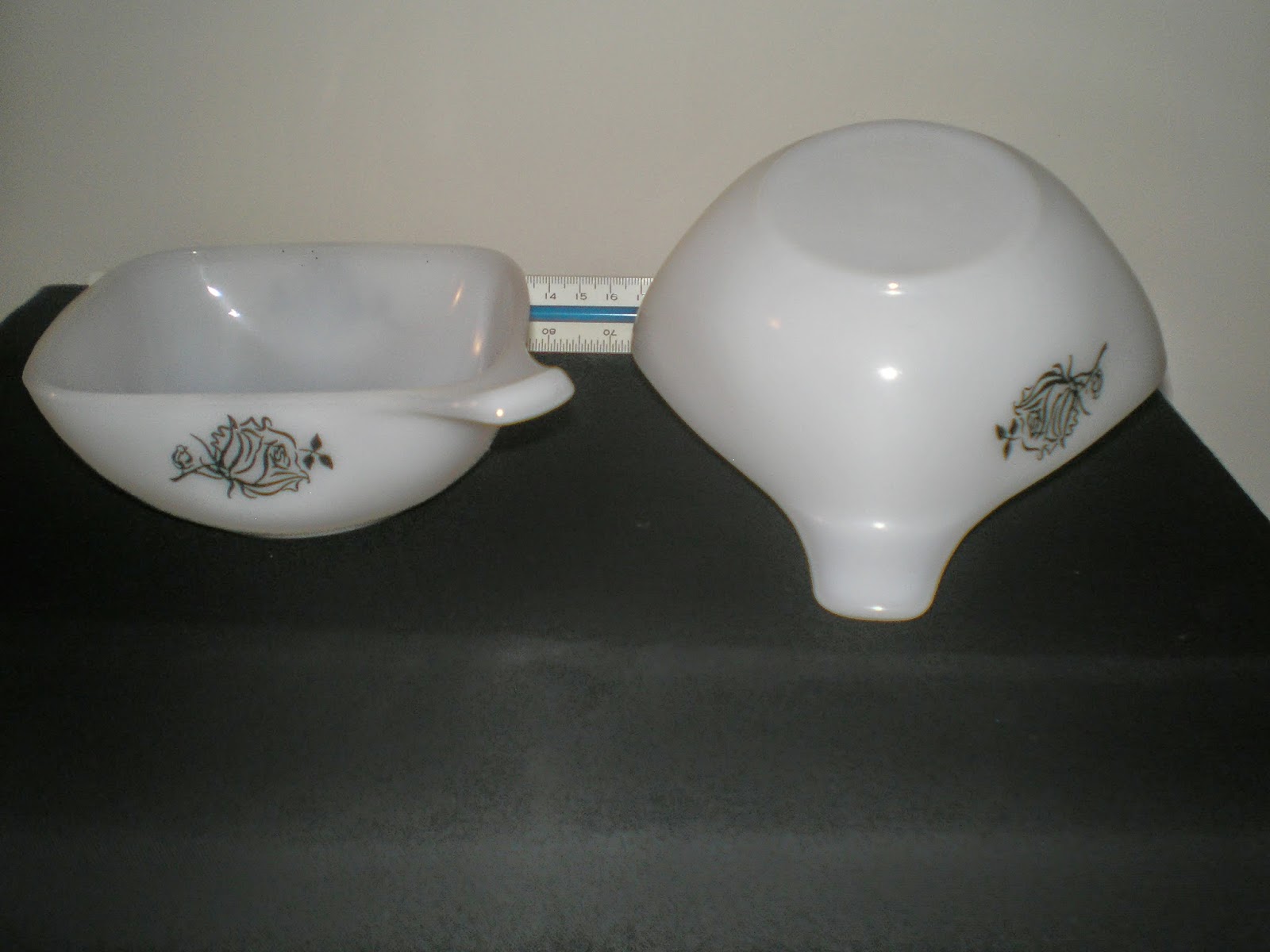
Milky white Pyroceram squared glass bowl with sides tapering to a raised circular footring, handle moulded to one corner.
Number
O RS 12 moulded into base
Production Date
1963/64
Width
118mm
Depth
45mm
Length (with handle)
163mm
Weight
225gm
Volume
325ml
Acquisition
Purchase
Waverly Antique Market
17th April 2014
Condition
 Very Good, unused
Rameking Reference Number
PYR 005-010


At the beginning of this blog is the statement that a lot of these ramekins are coming onto the market as people pass away.  Such is the case with these.  I bought them from a man who does house clearances.  These had been in someone’s kitchen for decades, still in the original box, untouched.  They were most likely a wedding present back in the mid 1960s.  They are marked with the words “Crown Pyrex” moulded into their base, along with a three-pointed crown symbol.


Pyrex is a name for glassware introduced by the American Corning and Incorporated in 1915.  Originally Pyrex was made from borosilicate glass.  Their website tells the story that their scientists developed a heatproof glass for railway lanterns.  Originally used in industrial applications, it became used as home ware when Bessie Littleton, wife of one of the Corning scientists asked him to bring home some glass to replace her broken casserole dish.  He brought her the bottom of some battery jars. 

In the 1940s the composition was changed for some products to tempered soda lime glass that is now the most common form of glass used in glass bake ware and has a higher mechanical strength so is less vulnerable to breakage when dropped (the main cause of breakage in glass bake ware).

These ramekins are made from a product called Pyroceram.  The manufacture of this material involves a process of controlled crystallization.  NASA classifies it as a “Glass-Ceramic” product.  NASA used a borosilicate coated quartz sand ceramic tile to cover the Space Shuttle providing a heat shield to resist the 3,000 degree F temperature on re entry.

Glass Ceramic materials share many properties with both glass and ceramics.  They have an amorphous phase and one or more crystalline phases and are produced by a “controlled crystallization” in contrast to a spontaneous crystallization that is not usually wanted in glass manufacturing.  Glass ceramics usually have between 30% [m/m] and 90% [m/m] crystallinity and yield an array of materials with interesting thermo-mechanical properties.

Pyroceram is a material developed and trademarked by Corning Glass in 1953.  Capable of withstanding temperatures of up to 450 degrees C (840 F), its development evolved from Cornings’ work in developing photosensitive glass.  Corning credits S Donald Stookey with its discovery; while he was conducting research he noted that an accidentally overheated fragment of glass resisted breakage when dropped.  These are an early example.

Another Australian Pottery, Studio Anna was also catering for the cookware market at the same time.  Introduced by owner Karel Jungvirt around the early 1960s, possibly as an Australian answer to Corning Ware (which came out in 1958), a range of decorated cookware he called Pyro-Ceracraft was developed. Available in a wide selection of designs and described as oven tableware, this range of heat resistant ceramics included casserole dishes, pie dishes and ramekins and was designed to be attractive enough to be brought straight from the oven to the dinner table.

Glass ceramics are mostly produced in two steps.  Firstly, a glass is formed in a glass manufacturing process.  The glass is then cooled down and is then reheated in a second stage.  In this heat treatment the glass partly crystallizes.  In most cases nucleation agents are added to the base composition of the glass-ceramic.  These nucleation agents aid and control the crystallization process.  Because there is no pressing and sintering, glass-ceramics have no pores , unlike sintered ceramics.  When a liquid crystallizes during a cooling phase of a process, the molecules organize from a primary nucleus to form complex structures.  These structures continue to grow until they impinge on neighbouring molecules, then they stop.  Properties of the item depend on the size of the molecular structures.

For crystal growth to start, a primary process called nucleation has to occur.  This is the focal centre around which the molecules can organize themselves.  The secondary process of crystal growth follows nucleation.   A nucleation agent is a foreign body added to create a new surface on which crystal growth can happen. Typically this phase takes the form of an agent to have a good match with the growing crystal.

The 2nd World War saw production of domestic ware drop to fairly low levels at Crown.  Most of their production was servicing the war effort, including contracts for the US Navy.  After the war, some of their early patterns made a comeback, but much of their production turned to ceramic glazed, colourful but streamlined and less decorative items, as was the fashion in the 1950s.  Much of their glass was mould-blown or involved hand tooling, but this ceased in 1968.

During the 1950s and 1960s tableware production continued, especially for homes, hotels restaurants and milk bars.  In 1963 Crown Crystal became a division of Australian Consolidated Industries (ACI) which set up a joint venture with American company Crown Corning in 1968, known in Australia as Crown Corning Ltd.  In 1998 ACI became an affiliate of Owens-Illinois in the USA, one of the world’s largest manufacturers of glass containers and a leading glass equipment manufacturer.

Established on the 25th of January 1939 and closing in 1982, Australian Consolidated Industries (ACI) was a holding company, consisting of subsidiaries that manufactured items such as bottles, glassware, sheet glass, engineering products and plastics.  Located at Spotswood in Sydney, New South Wales, Australia, Brisbane, Queensland and Dandenong, Victoria.  They had also opened a factory in Japan prior to the Second World War, and in Singapore, post war.

Crown Crystal Glass Pty. Ltd. was established in 1926 when the Australian Glass Manufacturers Co. Ltd. acquired Crystal Glass Ltd. and combined it with one of their existing subsidiaries, the Crown Glass Company.  The latter had been known as Crown Glass Works Ltd. prior to AGM acquiring it in 1921.  AGM owned other subsidiaries throughout Australia & New Zealand, making bottles & jars and sheet glass for windows.  Based in Sydney, Crown Crystal Glass would produce Grimwade hand-cut crystal, pressed glass tableware, and Agee Pyrex ovenware, the latter entering the market in 1932.

Although Pyrex had been made in England during the 1950s & 1960s and was marked with a crown symbol, the word "Crown" was never part of the brand name.  Items with this logo are not meant to be "Crown Pyrex".

A solid-coloured exterior finish first appeared on clear Agee Pyrex in 1938.  Alongside ordinary clear Pyrex, colour choices available up to 1942 were: Blue, Green, Biscuit/Primrose, Daffodil.  Biscuit and Primrose may or may not be the same colour; the descriptions in advertising vary.  Only plain clear Pyrex was offered for the duration of the 1940s, but Biscuit, Blue and Green returned in 1950.  Sometime during the 1950s, Coral (red) replaced Blue.

In 1959 opal Pyrex could be purchased in Australia for the first time, but it was not made in Australia.  British opal Pyrex from J. A. Jobling's was imported, starting with Daisy and Snowflake from the Gaiety product line.  In white Daisy on turquoise, a shallow oval open baker was specially produced for a Nestle's condensed milk promotion in 1959.  In place of JAJ's usual backstamp, "Nestle's" is embossed across the bottom.  Clear Pyrex from England had always had a presence in Australia, and along with opal Pyrex, this was maintained until at least the 1980s, possibly later. 

The Australian plant launched opal Agee Pyrex in 1961 with the Festive Ware product line.  Flannel Flowers, in Rose Pink, Haze Blue, or Buttercup, and Black Rose were the first patterns to debut.  Solid-coloured Copperglow (or Honey Glow) and ramekins in Harlequin colours also appeared in 1961.  Borrowing an American pattern from late 1961, Golden Pine was introduced in 1962.  Other colours were a light sky-blue, pale dove–grey blue, (think Yves Saint Laurant) Eau De Nil Green, Summer Orange, Tangerine and Sun Yellow.

Company names and brand names changed a few times during the lifetime of Australian-made Pyrex.  Upon diversifying into plastics in 1939, the parent company, AGM, changed its name to "Australian Consolidated Industries Ltd." (ACI), and the glass-making division was named "Australian Glass Manufacturers Co. Pty.", of which Crown Crystal Glass remained a subsidiary.

Pyrex products marketed by Crown Crystal Glass had been consistently branded as "Agee Pyrex" until 1963 when the brand name transitioned to "Crown Agee Pyrex".  A new logo was adopted at that time, a three-pointed crown.  The Agee name was dropped eventually and the product was called "Crown Pyrex" and "Crown Ovenware" through the remainder of the 1960s and into the 1970s.  Back stamps on some newer items simply state "Pyrex (TM) Ovenware" inside a circle, with no crown symbol.

Up to the early 1970s Crown Crystal Glass had not been affiliated with Corning Glass Works of the United States.  Corning already owned a subsidiary in Australia for processing and distributing Corning Ware, and in 1972 Crown Crystal Glass agreed to a merger with this division.  Both ACI and Corning Glass held interests in the newly-formed company, which was named "Crown Corning Ltd."

Crown Corning is now known as Crown Commercial Pty Ltd and continues to produce a large range of glassware for both commercial and domestic markets.  Ramekins of this type are not in the range.  The Crown Crystal Glass Company merged with the American company Corning in 1972 to become Crown Corning.

Crown Corning kept the existing crown logo, and continued to manufacture Australian Pyrex along with Crown Crystal's other glassware lines.  The Pyrex line remained throughout the 1970s, but it is unclear when it ceased production.  Being part of Corning's international network, Crown Corning also distributed Pyrex Ware from the U.S., the U.K. and France to Australian consumers.

There is now quite a bit of evidence that Crown Crystal was copying patterns from overseas after 1932.  Copied patterns have confused collectors so be careful on Internet auction sites.  In a case of what goes around comes around, Australian glass patterns are now also being copied, so be doubly careful. 

For more information, look at  http://www.ozcrowncrystal.com/  because that is where a lot of this has come from.  Glass is not my area and they have some very interesting information.  I have also copied large chunks of information from the Corelle Corner website at http://www.corellecorner.com

The inventor responsible for the discovery of this type opf glass, S Donald Stookey died on the 4th of November 2014 at the age of 99.  See his entry on Wikipedia for more information, it is very interesting.