Ramekin is thought to come from a Dutch word for "toast" or the German for "little cream."


Name

Ramekin

Variant

Ramequin, Ramekin dish.

Pronounced

(ram′ə kin)[RAM-ih-kihn]ræməkin

Function

English Noun

Plural

Ramekins

Hypernym

A type of dish

Purpose

Cooking

Etymology

French Ramequin from Low German ramken, diminutive of cream, circa 1706. middle Dutch rammeken (cheese dish) dialect variant of rom (cream), similar to old English ream and German rahm. Ancient French cookbooks refer to ramekins as being garnished fried bread.


Meaning

1. A food mixture, (casserole) specifically a preparation of cheese, especially with breadcrumbs and/or eggs or unsweetened pastry baked on a mould or shell.

2. With a typical volume of 50-250 ml (2-8 oz), it is a small fireproof glass or earthenware individual dish similar in size and shape to a cup, or mould used for cooking or baking and serving sweet or savoury foods.

3. Formerly the name given to toasted cheese; now tarts filled with cream cheese.

4. A young child usually between the ages of 3 months and 11 years exhibiting a compulsion to force or "ram" their head into various objects and structures.

These days, a ramekin is generally regarded as a small single serve heatproof serving bowl used in the preparation or serving of various food dishes, designed to be put into hot ovens and to withstand high temperatures. They were originally made of ceramics but have also been made of glass or porcelain, commonly in a round shape with an angled exterior ridged surface. Ramekins have more lately been standardized to a size with a typical volume of 50-250 ml (2-8 ounce) and are now used for serving a variety of sweet and savoury foods, both entrée and desert.

They are also an attractive addition to the table for serving nuts,dips and other snacks. Because they are designed to hold a serving for just one person, they are usually sold in sets of four, six, or eight. Ramekins now are solid white, round, with a fluted texture covering the outside, and a small lip. Please bear in mind that whatever you ask for them on Internet auction sites, someone is still getting the same thing in an op shop for peanuts.

However, there are hundreds of decorative ramekins that came in a variety of shapes and sizes. They came in countless colours and finishes and many were made by our leading artists and ceramicists. My collection has ramekins with One handle only, fixed to the body at one point only. If it has no handle, it is a bowl. If it has two, it is a casserole dish. But the glory day of the Australian Studio Art ramekin is well and truly over. See some here, ask questions or leave answers.

P.S. Remember, just as real men don't eat quiche, real ramekins don't have lids or two handles. Also remember, two handles makes it a casserole dish. Also, please note If it aint got a handle, it's just a bowl.

P.P.S. To all you cretins who advertise your ramekins by associating them with "Eames" or "Eames Era". Get your hand off it, you are not kidding anyone. The Eames people have told me that they never made ramekins.

P.P.P.s To all the illiterates out there in cyberspace, just as there is no "I" in team, there is no "G" in Ramekin. I am the Rameking, they are ramekins.

If you have a set of Grandma's ramekins at the back of a kitchen cupboard, have a look through the site, maybe you will identify them. Thank-you for looking.

There are many of you out there that have knowledge of Australian pottery. Please let me know if you have anything that I can add to the notes. It is important to get the information recorded. You probably know something that nobody else does.

Please note that while your comments are most welcome, any that contain a link to another site will no longer be published.

-


Thursday, September 8, 2011

Mystery Maker Marked C P Hill Has


Designer        
Mystery Maker
Maker
Mystery Maker
Marks
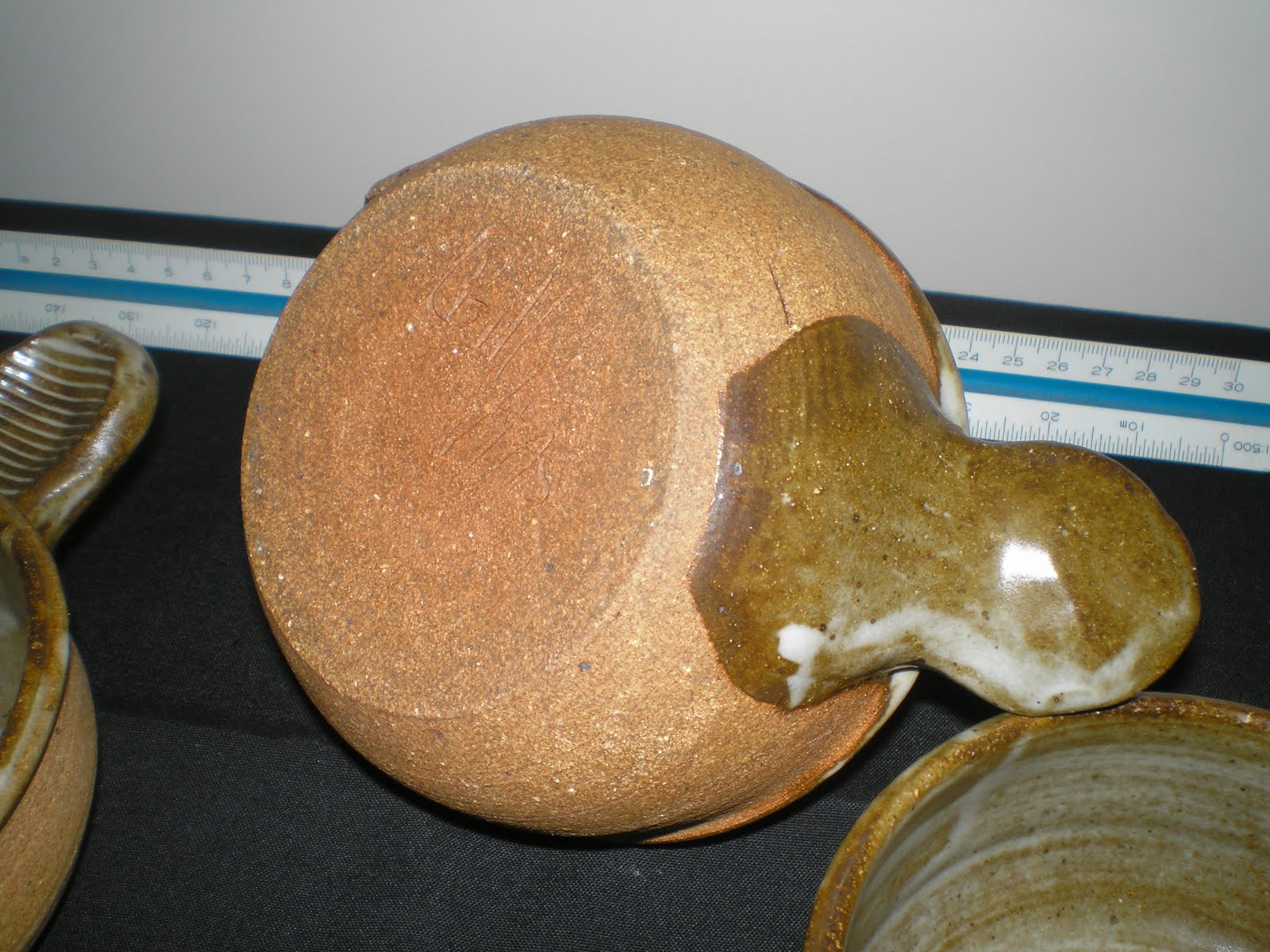
Incised “C P Hill Has”
Description
Wheel thrown earthenware bowl with flat base.  Glazed to interior, handle and lip.  Decorative motif applied to exterior side of bowl.  Ribbed tab handle.
Number
No number
Production Date
1980s
Width
120mm
Depth
50mm
Length (with handle)
157mm
Weight
220gm
Volume
375ml
Acquisition
Vinnies Mornington 8 Sept 2011
Rameking Reference No
MMM4 001-004


This type of primitive earthenware had a resurgence in Australia in the 1970s when a renewed interest in our past led to a revival of early arts and crafts.  Op shops are now full of this cheap pseudo-vintage earthenware.  Terra Cotta is probably the most common form around today.

Reminiscent of ancient pottery in shape and material, these ramekins are made from earthenware and are only glazed to the interior.  Easy to make and cheap to produce, earthenware is a type of pottery made from clay that has been lightly fired (at a low temperature below vitrification).  The first firing is around 1100-1150c.  This makes the body porous.  It becomes waterproof by the application of the glaze and a second firing.  This second firing melts the glaze and seals the pores in the earthenware. These ramekins are the colour of the clay, being light brown or buff.

The incised signature to the flat base appears to be “C P Hill Has”.  No information on this maker


Friday, September 2, 2011

Diana (Late)


Designer        
Diana Pottery Marrickville
Maker
Diana Pottery Marrickville
Marks
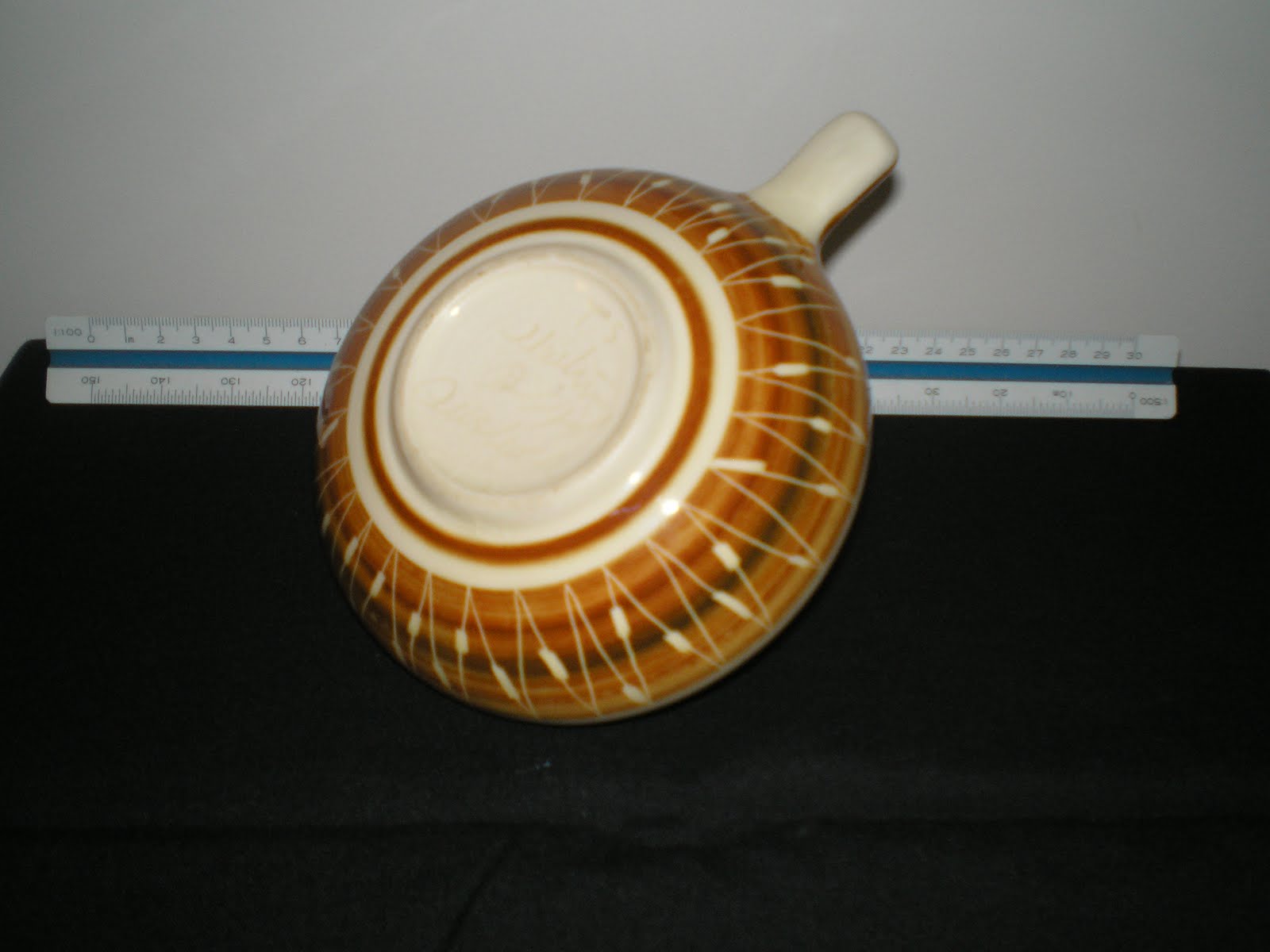
Stamped “Australian Guaranteed Ovenproof".  No decoration.
Description
Slipware straight sided bowl curving inward near base to circular unglazed footring.  Plain white interior and pale yellow (known as banana)  exterior.  Press moulded infill handle made to appear like curved U63 design.
Number

Production Date
Early 1970s
Width
110mm
Depth
45mm
Length (with handle)
165mm
Weight
195gm
Volume
250ml
Acquisition
Dromana Antique Market
Rameking Reference Number


Eric Cornwell Lowe was born in Melbourne in 1901 at East Brunswick, Victoria.  At the time, a number of potteries operated in the area, but Eric’s father (Arthur Horace Lindsay Lowe, 1868-1938) was a Salesman and later an Agent.  His mother was Amy Beatrice Catterall (b1871).  Eric moved to Sydney and married Vera Louisa Christopher in 1932, they do not appear to have had children.   Arthur and Amy moved up in the world, moving from Brunswick to Moonee Ponds, then to Caulfield, an affluent Melbourne suburb.

Young Eric was quite entrepreneurial in his late teens as he began importing cut glass and crockery from Germany and Czechoslovakia.  Timing was not on his side as this began in 1939.  This company was called “Eric C Lowe Pty Ltd.”   “Maunufacturers of Utility and Fancy Earthenware”.

The shareholders of this company were;

·        Eric C Lowe
·        Mrs Vera Louise Lowe
·        John Christopher
·        Winston McKenley Christopher
·        Brian Winter LeQueene
·        Josephine Mary Permewan (Victoria)
·        Ralph Rankin  (Victoria)

Directors of the company were

·        E.C.Lowe
·        V.L.Lowe
·        J.Christopher
·        W.M.Christopher
·         
The business was incorporated in New South Wales on the 11th of July 1939, having previously been carried on by Eric as a sole trader, and was given 401 ordinary and 2665 preference shares when incorporated. 

Eric had a large amount of stock on hand and could not sell it due to the stigma now attached to German goods.  So, during the Second World War (1941) Eric and Vera got Government contracts to produce ceramic wares (cream ware cups and mugs and pots and jugs) for the armed forces. Eric did not join up as many of his contemporaries did.  Many industries supplying the armed forces were “protected industries” and many of their employees were exempt from military service.  Most potteries at that time were geared for the war effort and the demand from Australian and American troops was enormous. 

Seen after the company incorporated, in 1941, Eric began making art pottery.  This did not last long as wartime restrictions meant that this was prohibited in May 1942.  They began making teapots, jugs, cups and mugs around May 1942.  During wartime, price control measures meant that Eric had to submit financial returns to the Commonwealth government.  This fixed the price that Eric could charge for the output. Thankfully, these records still exist.  These give detailed accounts of all the itemised accounting for the business. 

These are notable for showing that Fowler, Bakewell and Mashman were making similar items for the services.  Still, this did not stop the business from making a profit of 39.3% in 1940/41 and 26.0% in 1941/42.  Profits gradually dropped and the next year they only made about 13%.  In 1943/44, the profit was down to 10.7%.  The next year produced a deficit of £411.  Late in 1944, Eric had to repay 25 of his workers back pay because of a Womens Employment Board decision that he had underpaid them.  These were all women as most men had by then enlisted. 

Although born in Victoria, his pottery was started at 122-126 Marrickville Road, Marrickville, Sydney and it continued there until the early 1970s, when cheap copies and imports caused a drastic decline in sales and its eventual closure.  The giant Fowler works were already established there works in the area because of the clay found in the area, and later, Studio Anna commenced nearby.  They also purchased kaolin from the Pottery Clay Works for £3.15/- per ton.

In November 1945, a fire started by a lime kiln spread to the works and quickly destroyed much of the factory. Fire is an occupational hazard in potteries and brick works but nevertheless it was a devastating blow.  The works had been extensively refurbished the previous year.  Contracts from the Services were drying up and production had to revert to peace time items.  When the war finished, Arthur began had rebuilt and began making domestic pottery for the homes of the families of returned services people.  This included a large range of slip cast vases in a variety of gloss and matte colours, sizes and shapes, or sprayed to create a speckled texture,

Their output included such products as ceramic horse-head book ends, several other animal figures, (a pair of greyhounds was a popular product) tableware, utility and kitchenware. Over 200 different shapes were produced during their lifetime.  Some products were sold using the name “Hollywood.”  By the early 1950s the company had more than 70 employees and were producing a large range of hand painted articles which included "Waltzing Matilda" musical mugs and jugs, and produced bright "gumnut" pots with pale green and brown glazes.

The musical mugs and jugs played when lifted, but the movements were expensive and difficult to obtain, being imported from Switzerland, so many mugs and jugs that should have had movements were sold without at reduced prices. In the 1960s Diana diversified their range further into decorated oven and kitchenware, hand painted with maple, poinsettia, cornflower, blackberry, wattle and flannel flower designs.  In the 1960's, a variety of small slip cast vases hand decorated in gold were made for a gift shop in the Imperial Arcade Sydney which were marketed under the name 'Imperial'.  Although these are not ramekins, I have some of them.

After the Second World War there had been a massive increase in the number of potteries around Australia. Commercial, studio and backyard potteries were being established in the suburbs of most major cities and by 1955 there were over 12,000 people working in the quarrying and manufacture of clay related industries.  This also included brickworks.  After the war, Eric had changed production to domestic pottery and throughout the 1950s, Diana was the largest and most prolific pottery in New South Wales, producing hundreds of different products and designs, many hand painted. Native wildflowers were a popular motif.

Among them, as mentioned, the Flannel Flower, an iconic Sydney plant used in imagery and art since colonial times.  Sometimes known as the Sydney Flannel Flower, it is usually known as the Flannel Flower and was chosen to be the New South Wales floral emblem for the Centenary of Federation (1901-2001).  It is found in the sandstone national parks in the greater Sydney area and can be sometimes found in spectacular drifts.  The flowers are about 50mm in diameter and appear in Spring.  The stunning Pink Flannel Flower is rarely seen as it only appears in the summer following a bushfire.

Soon after the end of the Second World War, Eric began advertising for more staff and soon had a thriving business making home-wares for the thousands of ex-servicemen starting their families.  His pottery even had a staff canteen, far more advanced than many of the other one or two person companies operating on a shoestring budget.  In the mid 1960s, they (Diana Pottery (Vic) Pty Ltd) had a shop in Melbourne at 343 Little Collins Street. 

The potteries around Australia employed thousands of people, many given their start in Australia following migration from Europe after the second word war.  Eric Jungvirt who started Studio Anna was one who started with Eric at Diana.  I think it fair to say that you would have had a piece of Diana pottery in yours or your parents home at some stage, probably a ramekin, a mixing bowl or a vase. At their peak, Diana employed around 70 people but this had declined to around 30 by 1970.  They continued on for a few more years calling their output “Dana”. 

In Australia, the Whitlam Government had cut tariffs without warning by 25 percent in 1973.  1974 saw an increase in imports of 30 percent.  By mid-1974, Australia was in an economic slump with unemployment rising significantly.  Short-term credit rates rose to extremely high levels and this caused prices to spike sharply, and according to Government figures, inflation topped 13 percent for over a year between 1973 and 1974.  On top of these problems, wage parity was legislated for female workers meant an increase in wages costs.It was in this climate that Diana fell on hard times and ceased production.  Eric was by then in his early 50s.

Much of the Dana ceramics were copies of the later “Nefertiti” ramekins, with a rough textured (Avocado) exterior and a brown glazed lip and interior. They also produced wares using the names Hollywood, Imperial and just plain Australian.  Check out the Diana website for lots more.   Also, a potter at Bendigo Pottery told me that the conveyor that moves the pottery around the Bendigo Pottery today was said to have come from the old Diana Pottery after it closed in 1974.  The entire Marrickville site consisting of the Fowler, Diana and Studio Anna potteries was demolished and subdivided in 1982.  Eric died in Sydney NSW on the 10th February 1977 age 76.  Vera lived on for many years.


Thursday, September 1, 2011

Made In Japan


A lot of people have ramekins that were made in Japan.  They began to arrive in Australia after the Trade Agreement between the two countries was signed on the 6th of July 1957.  Australia thus became the first country to trade with Japan after World War II.  Because of the standard of living in the respective countries at the time, trade was mostly one way for manufactured goods.  The signing of this agreement began a shift in Australia’s reliance on Great Britain, with Japan quickly becoming Australia’s most important trading partner. Initially, their ramekins were copies of existing Australian makers with a few decorative changes.  This was common practice for the times as many Australian makers copied other designs anyway.  Copyright compliance in Australia was viewed somewhat more flexibly than today.  Many Japanese copies were of Martin Boyd designs.  That is why I have added this item.

It is sometimes difficult to trace the makers in Japan as they would make up western names to add to their wares.  Now, most marks have been washed off over the years.   Others simply had the word “Japan” stamped on the base, or “Made in Japan” moulded into the base. 

Some of the identified makers are:

Whitco.  Not to be confused with the door furniture people, Whitco made ramekins that were very similar to the later Ray Cook and Bendigo Pottery their brown glaze was close to the Bendigo glaze, but the ramekins had a much more sculptured and comfortable handle.  I think that the thin glaze was applied on purpose to make people think that they were an Australian product, because no Japanese potter worth his salt would produce anything as shoddy.

Grizelle.  They also appear to be a copy of some of the Martin Boyd ramekins of the time.  Or maybe Boyd copied Griselle, who knows?  Grizelle was a West German exporter, who rebadged many West German Pottery pieces and marked them as Japanese, Australian & New Zealand, producing pottery during the 50's and 60's. The German and Japanese potteries both produced export wares (a lot were for the souvenir market) and both exported to Australia and the US (probably UK too) The Australian pottery produced utilitarian ware and figurines for the domestic market.  Just where this pottery was located, or if an existing maker produced them is not known.  There are many different marks and stickers found on the German/Japanese/Australian versions suggesting that these were produced by different potteries rather than from a distributor selling wares from 3 different countries.  In Germany it appears to have been made by Duemler and Breiden, Hoehr Grenzhausen (impressed crossed lines with DB) and the printed Grizelle mark with Germany.  The brand name Grizelle does not appear in any German literature about ceramics of the 1950s (Macus, etc.).  The marks (stickers) all have the leaping antelope, sometimes on a gold sticker, sometimes embossed to the base.  


Later, ramekins from Taiwan and Korea overhauled Japanese products as Australian makers went to the wall, but that's another story!

Sunday, August 28, 2011

Martin Boyd / Tom Sanders

Designer        
Tom Sanders
Maker
Martin Boyd Pottery
Marks
Incised “TS” “Martin Boyd Australia” under glaze to base
Description
Slipware bowl with balloon sides and circular base and stem handle.  Brown glaze to interior of bowl with brown banding to exterior, excised with a zig zag pattern.
Number

Production Date
1948/49
Width
127mm
Depth
45mm
Length (with handle)
157mm
Weight
230gm
Volume
375ml
Acquisition
Camberwell Sunday Market 28 Aug 2011
Rameking Reference Number
MBS 001


In 1946, while Guy Boyd was studying at the East Sydney Technical College, he worked at night with Norma Flegg in her basement pottery in Cremorne. They originally used the name “Guy Boyd” incised on the base of their ramekins, but in 1948, they began using the name “Martin Boyd” when Norma’s husband Leonard joined the company.  Guy returned to Victoria in 1950 and the company in Sydney continued to use the name until it ceased production in 1964.  They also used a variety of other names as they produced pottery for department stores and commemorative wares.

 This ramekin is incised "Martin Boyd" to the base. Many people can be confused by this and think that Martin was another of the Boyds’, yes he was, a writer, not a potter.  But Guy used Martin as it is actually one his middle names. Why did he choose to use his middle name on these items?  Who knows. 

The initials “TS” refer to Thomas Percy Sanders who was born on the 16th of February 1924.  Others record his birth in 1921 or 1925, but it was actually 1924.  After serving in the Royal Australian Air Force as an Aircraftsman in WW2, Tom moved north from Melbourne and started working in Guy Boyd's Sydney pottery as a potter and ceramic decorator. He moved back to Melbourne in 1949 and worked at the Hoffmann pottery in East Brunswick. He then spent a year with Arthur Boyd at Murrumbeena in suburban Melbourne before setting up his own pottery "T & E Sanders" at Eltham in 1950 and later “Dorian Sands”.

The Martin Boyd Pottery developed their own high quality glazes and at its height, employed up to eighty people. They also used a variety of other names as they produced pottery for department stores and commemorative wares. Many of the ramekins I have that are signed as Martin Boyd are smaller than his "Guy Boyd" ones. There are larger ones with the same signature most with reverse matching colours. So there it is folks. Just because it says Boyd on the bottom, it ain’t necessarily so. Collect them just the same.  If you are lucky enough to find some that have “TS” on them, buy them.


Friday, August 12, 2011

Crown Pyrex


Designer        
Crown Pyrex
Maker
Crown Pyrex
Marks
Moulded ”Crown Pyrex” to base in cartouche with stylized three pointed crown emblem above with pattern Number below
Description
Milk Pyroceram squared glass bowl with sides tapering to circular footring, handle moulded to one corner. 18ct gold leaf pattern with two strawberries below to two opposite sides.  Gold lining decoration firing occurs after each piece has been individual hand painted with a very fine film of liquid gold and is then fired at 750 degrees C to 850 degrees C.
Number
0-RS-12 with each ramekin having a number moulded to the right side of the cartouche
Production Date
No earlier than 1972
Width
120mm
Depth
45mm
Length (with handle)
160mm
Weight
220gm
Volume
300ml
Acquisition
Vinnies Oakleigh 12 August 2011
Condition
 Very Good, no chips or scratches
No, I have not forgotten that this is for Australian Art Studio ramekins, but I could only resist these for so long.  If you have ever been op-shopping anywhere in Australia then you would have seen these ramekins for sure.  The shape remains the same but the outside design varies.  Everywhere I went, I would see them on the shelves with the other ramekins that I have collected and I never even considered them.  Because they are so rugged in construction, they still survive in full sets.  These are marked with the words “Crown Pyrex” moulded into the base.  They were made by an Australian company that started out as Crown Crystal Glass in 1926 following the amalgamation of a number of small glass making hand production works. These were the Balmain Glass Works, Crown Glass Works and the Crystal Glass Works.


Look into any Australian family’s cupboards any time between the 1920s and the 1960s and you would be sure to find wares from the Crown Crystal Glass Company, who had a virtual monopoly.  They produced some distinctly Australian patterns.  Most (although not all) of the early designs are Crown’s own, reflecting the Australian cultural obsession of the first half of the 20th century with native flora and fauna.  Their quality did not reach that of American pressed glass until after the second-world war, and their production values could be quite low, but that is part of their appeal.

Pyrex is a name for glassware introduced by Corning Incorporated in 1915.  Originally Pyrex was made from borosilicate glass.  In the 1940s the composition was changed for some products to tempered soda lime glass that is now the most common form of glass used in glass bakeware and has a higher mechanical strength so is less vulnerable to breakage when dropped (the main cause of breakage in glass bakeware).

These ramekins are made from a product called Pyroceram.  The manufacture of this material involves a process of controlled crystallization.  NASA classifies it as a “Glass-Ceramic” product.  Glass Ceramic materials share many properties with both glass and ceramics.  They have an amorphous phase and one or more crystalline phases and are produced by a “controlled crystallization” in contrast to a spontaneous crystallization that is not usually wanted in glass manufacturing.  Glass ceramics usually have between 30% [m/m] and 90% [m/m] crystallinity and yield an array of materials with interesting thermomechanical properties.

Pyroceram is a material developed and trademarked by Corning Glass in 1953.  Capable of withstanding temperatures of up to 450 degrees C (840 F), its development evolved from Cornings’ work in developing photosensitive glass.  Corning credits S Donald Stookey with its discovery; while he was conducting research he noted that an accidentally overheated fragment of glass resisted breakage when dropped. 

Another Australian Pottery, Studio Anna was also catering for the cookware market at the same time.  Introduced by owner Karel Jungvirt around the early 1960s, possibly as an Australian answer to Corning Ware (which came out in 1958), a range of decorated cookware he called Pyro-Ceracraft was developed. Available in a wide selection of designs and described as oven tableware, this range of heat resistant ceramics included casserole dishes, pie dishes and ramekins and was designed to be attractive enough to be brought straight from the oven to the dinner table.

Glass ceramics are mostly produced in two steps.  Firstly, a glass is formed in a glass manufacturing process.  The glass is then cooled down and is then reheated in a second stage.  In this heat treatment the glass partly crystallizes.  In most cases nucleation agents are added to the base composition of the glass-ceramic.  These nucleation agents aid and control the crystallization process.  Because there is no pressing and sintering, glass-ceramics have no pores , unlike sintered ceramics.  When a liquid crystallizes during a cooling phase of a process, the molecules organize from a primary nucleus to form complex structures.  These structures continue to grow until they impinge on neighbouring molecules, then they stop.  Properties of the item depend on the size of the molecular structures.


For crystal growth to start, a primary process called nucleation has to occur.  This is the focal centre around which the molecules can organize themselves.  The secondary process of crystal growth follows nucleation.   A nucleation agent is a foreign body added to create a new surface on which crystal growth can happen.  Typically this phase takes the form of an agent to have a good match with the growing crystal

The 2nd World War saw production of domestic ware drop to fairly low levels at Crown.  Most of their production was servicing the war effort, including contracts for the US Navy.  After the war, some of their early patterns made a comeback, but much of their production turned to ceramic glazed, colourful but streamlined and less decorative items, as was the fashion in the 1950s.  Much of their glass was mould-blown or involved hand tooling, but this ceased in 1968.

During the 1950s and 1960s tableware production continued, especially for homes, hotels restaurants and milk bars.  In 1963 Crown Crystal became a division of Australian Consolidated Industries (ACI) which set up a joint venture with American company Crown Corning in 1968, known in Australia as Crown Corning Ltd.  In 1998 ACI became an affiliate of Owens-Illinois in the USA, one of the world’s largest manufacturers of glass containers and a leading glass equipment manufacturer.

Crown Corning is now known as Crown Commercial Pty Ltd and continues to produce a large range of glassware for both commercial and domestic markets.  Ramekins of this type are not in the range.  The Crown Crystal Glass Company merged with the American company Corning in 1972 to become Crown Corning.

There is now quite a bit of evidence that Crown Crystal was copying patterns from overseas after 1932.  Copied patterns have confused collectors so be careful on Internet auction sites.  In a case of what goes around comes around, Australian glass patterns are now also being copied, so be doubly careful.  For more information, look at  http://www.ozcrowncrystal.com/  because that is where a lot of this has come from.  Glass is not my area and they have some very interesting information.


Monday, July 18, 2011

Mystery Maker Unmarked No 2


Designer        
Unknown
Maker
Unknown
Marks
No marks
Description
Mould formed glazed slipware ramekins.  Lemon coloured exterior with uncoloured base, white interior with black hand painted vertical stripes to interior sides.  Flat base with spur marks. Folded handle similar to Diana (U63 pattern)
Number
Not marked
Production Date
Possibly late 1950s
Width
135mm
Depth
34mm
Length (with handle)
178mm
Weight
225gm
Volume
250ml
Acquisition
Camberwell Sunday market

Mystery Maker Unmarked No 1


Designer        
Unknown
Maker
Unknown
Marks
No marks
Description
Wheel made small well made glazed ramekin, cream exterior with harlequin interior.  Stub stem handle with small grip handle on opposite side.  Pronounced spur marks to base.
Most likely Japanese
Number
No marks
Production Date
Possibly late 1960s
Width
102mm
Depth
40mm
Length (with handles)
138mm
Weight
200gm
Volume
200ml
Acquisition
Crystal Brook Antiques, South Australia
Purchased from the deceased estate of the local Doctor.


These are from a fondue set; remember them?  Anyone holding dinner parties in the 60s or 70s will.  These ramekins would hang in a set of six from brackets around the outside of a thin metal frame that had a matching pan sitting above a flame, usually a candle, similar to the one shown above.  


Rameking Romance tip; Gentlemen who wish to improve their chances with the ladies would be well advised to resurrect a fondue set.  Not the cheese dip that will have them run a mile, but with melted chocolate.  If you have got her to your place, she is already interested.  Get her to dip strawberries into hot melted chocolate and you on a winner.  Ladies love a man that cooks, and they love chocolate even more.  Team it with fruit, preferably strawberries, and they think it is healthy.  In ladies, the chocoholic gene is far more developed and responsive than in gentlemen.
Try this recipe;
http://www.toblerone.co.uk/toblerone1/page?siteid=toblerone1-prd&locale=uken1&PagecRef=638