Ramekin is thought to come from a Dutch word for "toast" or the German for "little cream."


Name

Ramekin

Variant

Ramequin, Ramekin dish.

Pronounced

(ram′ə kin)[RAM-ih-kihn]ræməkin

Function

English Noun

Plural

Ramekins

Hypernym

A type of dish

Purpose

Cooking

Etymology

French Ramequin from Low German ramken, diminutive of cream, circa 1706. middle Dutch rammeken (cheese dish) dialect variant of rom (cream), similar to old English ream and German rahm. Ancient French cookbooks refer to ramekins as being garnished fried bread.


Meaning

1. A food mixture, (casserole) specifically a preparation of cheese, especially with breadcrumbs and/or eggs or unsweetened pastry baked on a mould or shell.

2. With a typical volume of 50-250 ml (2-8 oz), it is a small fireproof glass or earthenware individual dish similar in size and shape to a cup, or mould used for cooking or baking and serving sweet or savoury foods.

3. Formerly the name given to toasted cheese; now tarts filled with cream cheese.

4. A young child usually between the ages of 3 months and 11 years exhibiting a compulsion to force or "ram" their head into various objects and structures.

These days, a ramekin is generally regarded as a small single serve heatproof serving bowl used in the preparation or serving of various food dishes, designed to be put into hot ovens and to withstand high temperatures. They were originally made of ceramics but have also been made of glass or porcelain, commonly in a round shape with an angled exterior ridged surface. Ramekins have more lately been standardized to a size with a typical volume of 50-250 ml (2-8 ounce) and are now used for serving a variety of sweet and savoury foods, both entrée and desert.

They are also an attractive addition to the table for serving nuts,dips and other snacks. Because they are designed to hold a serving for just one person, they are usually sold in sets of four, six, or eight. Ramekins now are solid white, round, with a fluted texture covering the outside, and a small lip. Please bear in mind that whatever you ask for them on Internet auction sites, someone is still getting the same thing in an op shop for peanuts.

However, there are hundreds of decorative ramekins that came in a variety of shapes and sizes. They came in countless colours and finishes and many were made by our leading artists and ceramicists. My collection has ramekins with One handle only, fixed to the body at one point only. If it has no handle, it is a bowl. If it has two, it is a casserole dish. But the glory day of the Australian Studio Art ramekin is well and truly over. See some here, ask questions or leave answers.

P.S. Remember, just as real men don't eat quiche, real ramekins don't have lids or two handles. Also remember, two handles makes it a casserole dish. Also, please note If it aint got a handle, it's just a bowl.

P.P.S. To all you cretins who advertise your ramekins by associating them with "Eames" or "Eames Era". Get your hand off it, you are not kidding anyone. The Eames people have told me that they never made ramekins.

P.P.P.s To all the illiterates out there in cyberspace, just as there is no "I" in team, there is no "G" in Ramekin. I am the Rameking, they are ramekins.

If you have a set of Grandma's ramekins at the back of a kitchen cupboard, have a look through the site, maybe you will identify them. Thank-you for looking.

There are many of you out there that have knowledge of Australian pottery. Please let me know if you have anything that I can add to the notes. It is important to get the information recorded. You probably know something that nobody else does.

Please note that while your comments are most welcome, any that contain a link to another site will no longer be published.

-


Sunday, March 2, 2014

Remued / Keryl A1


Designer        
Reg Hawkins
Maker
Allan James / Keryl (at Oakover Road)
Marks
Incised “A1” to base
Material
Wheel thrown clay 
Description
Clear glazed bowl with spoon handle attached to outside top of rim.  Cream glaze to exterior and handle, speckled harlequin glaze to interior.  Flat circular foot ring.
Condition
Very good
Number
Incised “A1” to base
Production Date
Early 1950s
Width at rim
85.5mm
Width at Base
65.9mm
Depth
40mm
Length (with handle)
11.45mm
Weight
140gm
Volume
125ml
Acquisition
Purchase
Tyabb Antiques
2nd March 2014
Rameking Reference Number
REM A1 001-004


These small ramekins were made by Allan James.  That is about the only certainty.  The location of their manufacture is open to conjecture.  None of these A1 and A2 ramekins were marked as Remued although their design is in their shape books.  

Premier Pottery in Preston commenced in 1929 by friends David Dee (1877-1934) and Reg Hawkins (1894-1971). Both men had had much experience in pottery before beginning this small business, set up at 52 Oakover Road in Preston. Previously this site was used for curing bacon. This was a perfect location for opening a pottery as on the corner of Oakover and St. Georges road at that time, was a large clay pit, virtually next door to the pottery.

Premier Pottery Preston was a small undertaking, unusual in that it produced only art pottery, all of it hand-thrown. David Dee threw the pots, Reg Hawkins painted them, and David's son Walter Dee (1904-1987) did the glazing and firing.  Walter helped his father construct a coal-fired kiln out of second-hand bricks and also worked at the pottery glazing and firing. Dee was the thrower (the potter that made the actual items with the wheel) and Hawkins, an Englishman that had once lived with the Dee family in Box Hill, was the decorator. Walter worked as the glazier after learning glazing and kiln firing. 

Earlier, in 1912 David Dee had set up an insulator works but was soon working in various other potteries around Melbourne suggesting this business did not take off. When he co-founded Premier Pottery he was still working part time. Dee was very good at throwing and produced all the early pottery.  His work was mostly for commercial purposes and the few pieces on which he signed his own name were made for use of his own family.  Sadly Dee passed away in 1934, five years after Premier Pottery opened and was not present to see the future successes of the business.

Dee, along with his five brothers, was an apprentice at Campbell's pottery in Launceston, Tasmania, where he leant to use the potter's wheel.  His father Thomas was a friend and neighbour of John Campbell.  Hawkins grew up in Poole, England, and trained as a decorator of pottery before emigrating to Australia. Dee and Hawkins, seeing an opening in the market for decorative ware, established their own business at a time when a number of major potteries were closing due to the Great Depression.   Thomas and his other sons; David Henry, George Henry, John and Thomas Jnr all worked in the pottery trade around Melbourne.  They all lived together at 49 Victoria Street East Brunswick, just up the road from the pottery.

Premier's earlier work reflects the influence of English potteries, due to Hawkin's background and training, and utilized underglazes and coloured glazes imported from Britain. However Premier's soon developed a style that was distinct, and by the 1930s became a highly established and successful business. Throughout this period Premier was characterized by experimentation in glaze techniques and surface treatment, along with the incorporating of Australian motifs into their designs.

The products of Premier Pottery Preston were not mass-produced. Everything was hand-made.  In such an environment, inevitably pieces were produced that were not intended for the retail market but were family gifts, experiments, or simply giving rein to the potter's creative spirit. Although perhaps not strictly 'Remued' many such pieces are nowadays amongst the most interesting and sought-after.

They are often incised with the potter's name or initials. Quite a few are signed by the principal throwers at Premier, David Dee and Allan James (1914-1979).  Others were involved too; industry potters, sometimes moonlighting from jobs at bigger potteries; and studio potters, notably Margaret Kerr, (1898-1958) Una Deerbon (1882-1972) and John Castle-Harris (1893-1967).

In 1934, they added a smaller kiln to the set-up, which included throwing and drying rooms and a storeroom for goods ready for distribution by F.R. Barlow and Sons in the city and the Primrose Pottery Shop (which was upstairs, in a building behind Bunnings on Little Collins Street) listing wares by various makers priced from 6d in 1932 and 1/6 in 1936. Edith MacMillan commissioned works for sale in her shop - just some of the domestic wares the pottery produced for her (See Primrose Pottery).

But the person who made the Remued pots so distinctive was Margaret Kerr, who modelled the gumnuts, gum leaves, berries and branches that were applied to the wheel-thrown forms. Catherine Webb, great-granddaughter of David Dee, writes: "It is possible that it was her idea to begin using Australian imagery. Unpaid, Kerr would go to the pottery to work on her own pieces, modelling animals and so on, which the pottery would then fire and glaze for her; some of Kerr's images were then incorporated into the work of the pottery. There is no evidence of this being other than a mutually beneficial relationship: no tension emerged over ownership of the designs."

Kerr was the daughter of painter Alexander Kerr and had learnt pottery from Merric Boyd (1888-1959); his influence at Premier Pottery was enormous.  Kerr also studied sculpture at the Working Man's College (now RMIT) and taught clay modelling at Brunswick Technical School.  The confidence and exuberance of her forms suggest a passionate personality

Pottery produced at Premier Pottery Preston is better known as the Remued range. The main characteristic of these pieces is the drip glaze style. Before Premier Pottery produced the Remued range they branded their pieces as PPP or Pamela. The name ‘Remued’ comes from Reg Hawkins’ second wife.  Nonie Deumer was her maiden name, which spelt backwards is Remued. She became an investor in the company after David Dee’s death.
 
Reg Hawkins had sole control of the company after Dee’s death and that generated much ill-will between him and Dee’s widow. This ended up being quite a difficult time for Premier Pottery as she then refused Hawkins access to Dee’s glaze recipe book containing much of the company’s trademark styles. Hawkins offered £100 to resolve the issue but was refused by Mrs. Dee. Eventually Walter Dee’s own glazes worked their way into the Remued range and the company continued to succeed. 

The continuous success of Premier Pottery was also because, two years before Dee’s death, a 17-18 year old Alan James was riding his bicycle down Oakover road when Reg Hawkins offered him a job.  Alan accepted and became an apprentice thrower working under David Dee.  Alan picked up the skill easily and was faster and better than anyone else in the company.  He enjoyed his work and would practice at every opportunity.  Alan’s skill and speed resulted in Premier Pottery becoming the leading business in its field as it was able to produce much more than the competition with little resources.

After Dee’s death, Alan was the only thrower and was responsible for all pot shapes from then on. He was also skilful with decorating pieces after having taken classes with Margaret Kerr.  As Alan James took over the decorating the style changed slightly and became more intricate, for example single veined gumleaves can be seen in earlier work but in James’ work the leaves were multi-veined. 

Margaret Kerr began working at the Premier Pottery from the early thirties, having worked previously as a clay modelling instructor.  She was responsible for a lot of the Australian floral and fauna decoration on the Remued range and may have even made the moulds of gumleaves, gumnuts and koalas that appeared often as decoration on the various pieces.  She was a talented artist though she only exhibited her own work during her student years in the mid 20s.  Originally Kerr would visit the pottery to work on her own pieces which the pottery would fire and glaze for her, and in return she would contribute to the decoration of the pieces being made.  Margaret Kerr’s decoration was another contributing factor to the ongoing success of Premier Pottery up until World War II, when she retired.

Alan James was the only worker to remain at the pottery during World War II. The only reason the pottery was able to remain operational was because the government had contracted the pottery to produce acid stoneware jars and white army crockery. Making any decorative pieces was forbidden at the time because of wartime restrictions.


The potter responsible for most Remued production was Allan James who had originally been taught throwing by David Dee.  In 1951-52 he set up a second small pottery operation using an electric kiln, not at Oakover Road but in the backyard of his home at 16 Esther St, Preston.  It may be speculated that he was preparing to abandon Premier Pottery, which probably would have meant the end of Premier because the pottery revolved around him.  Whatever transpired it is known that, about that time, his position at Premier changed from being an employee in a firm owned by Reg Hawkins to being a co-owner.  Alan continued to work by day at Premier and worked evenings at home as well.

The 'backyard' product, not surprisingly, bore a close similarity in style to contemporary Remued production from Oakover Road.  A new numbering series was instigated, the 'A' Series, marketed alongside the Later Series through the same agents. Like the Later Series the 'A' Series started at number 1 but was distinguished by the prefix letter 'A'.  Initially 'A' Series shapes were nearly all new, not repeating previous shapes. They included that favourite of 1950s potters, ramekins (numbered A1 & A2) plus lamp bases, dishes and vases.

Despite Premier Pottery in Preston producing large quantities of ceramic work, they maintained a studio, or handmade approach to their product. The people involved had, with few exceptions, trained in large commercial potteries but saw value in creating pottery by using the potter's wheel without the use of plaster moulds except for decoration. This is significant for the time, as the studio potters were developing sound markets, but were essentially working on a very small scale. There were also many large scale commercial potteries in existence but these tended to make thrown pots or household items as a sideline to industrial or builders' supplies. The Premier Pottery ran for nearly thirty years, filling the space between the studio potters and the factories in a depressed and competitive market.

In 1946 Premier Pottery was back to the level of production it was at before the war but strong competition arose from cheap Japanese imported goods, hindering the success of Premier Pottery. This trend continued, ultimately forcing them to close their doors for good in 1956.

Premier Pottery Preston finally ceased production following, in part difficulties over the lease of the premises.  Factors such as management and rental disputes, changes in the market place, and a decrease in sales, eventually led to their closure.

Despite having a studio atmosphere, Premier Pottery Preston was not a relaxed workplace; the pressure was on. Incising signatures and shape numbers was commonly done late in the day, by anyone available, and mistakes happened. Such mistakes present a problem for cataloguing.  An unexpected or anomalous number cannot necessarily be dismissed as a 'mistake', and while some shapes are sufficiently plentiful and well-documented that a mistaken example can be confidently recognized, is not always the case.


 Allan James then went on to establish Kerryl Pottery in the nearby Melbourne suburb of Reservoir, at 53 Banbury Rd, and transferred production of 'A' Series items there. Reg Hawkins did not join him.  The series was extended with new shapes and new styles of glazing reflecting changing fashions.  Slip-casting was introduced for some designs, replicating popular pieces from other potteries including Beswick, Shorter & Son and E.G.Greenway.  Many familiar shapes from the Later Series also made a re-appearance in the Kerryl range, particularly after about number A88.  The name may be derived from Margot Kerr who worked at Remued from the early 1930s and was responsible for introducing the now highly collectable gumleaf/gumnut design, although it is believed that it was named for Kerry, the son of Allan and Myrtle James.

Premier Pottery Preston is considered a high point in the history of Australian decorative pottery and pieces are sought and displayed by leading museums such as the National Gallery of Victoria.
 
There was an exhibition of Remued and Preston Premier pottery held at Bundoora Homestead in 2005.

Compiled from
Darebin Libraries
Powerhouse Museum 
Remued.com
Penny Webb “Gumnuts and Glazes”


Monday, February 3, 2014

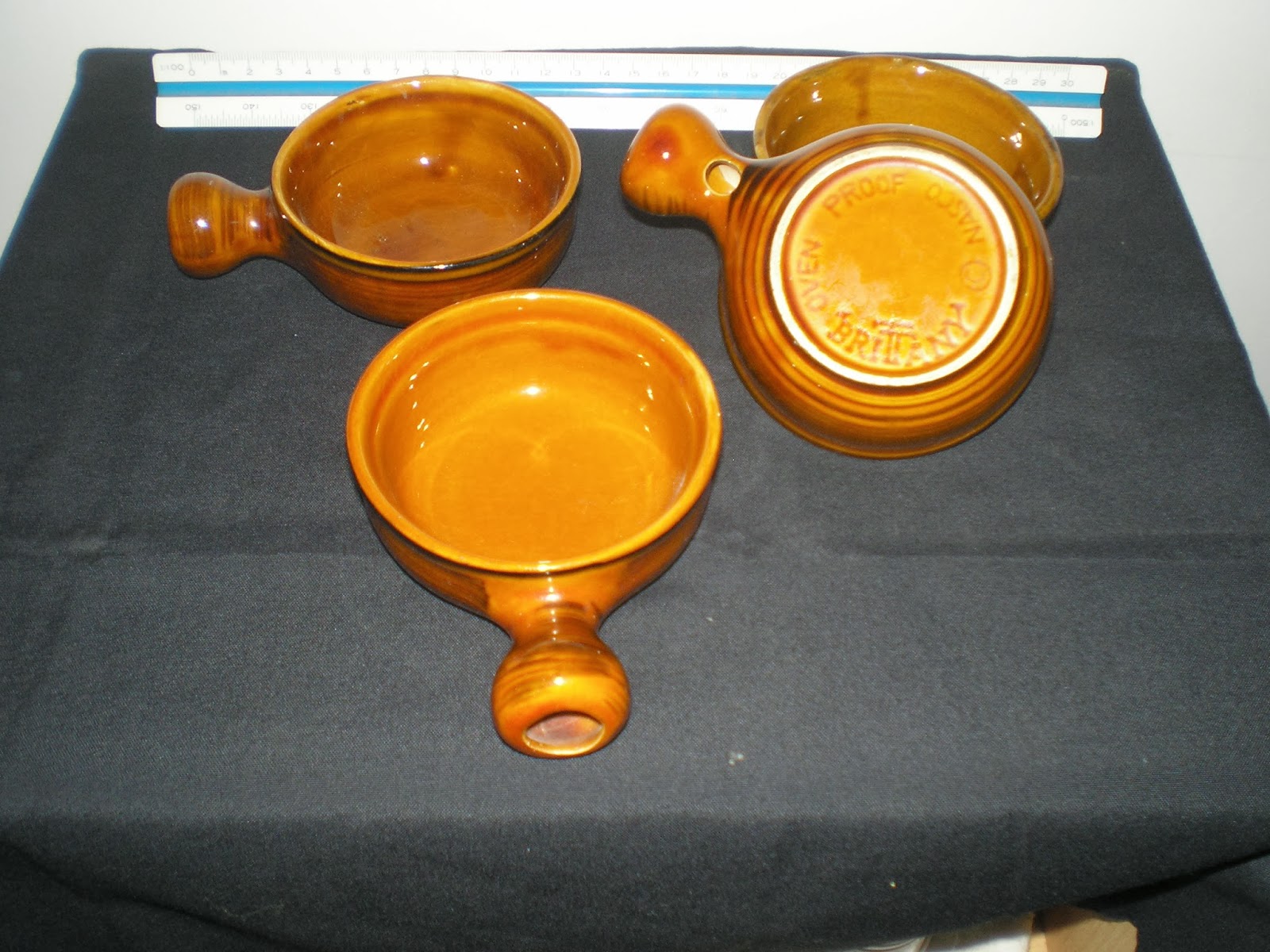
NASCO Brittany


This tureen (or casserole or soup pot) and ramekin set was made by the National Silver Company of Nagoya, Japan and marked “NASCO Brittany”. It could be used as a fondue set also.   The chances are that it was made by one of the many ceramic companies in the Owari province.  This area produced varieties of porcelain and pottery over many centuries, more particularly Seto ware. 


It consists of a metal frame holding a ceramic bowl over a metal container for a flame to heat the contents.   Six ramekins are held by metal hooks on the outside of the metal frame, through holes in the underside of the handles.  This set came in two different metal frames, the other being a tree holding the ramekins vertically. 


Various other china dinnerware has been produced by NASCO, but it seems that NASCO Brittany was a one-off, short lived experiment.  You can find many odd ramekins in op-shops for not much money.  Rarely do you find a full set like this.

Saturday, February 1, 2014

Old Cheese Factory Craft Centre


Designer        
Not known
Maker
Not Known
Marks
Stamped “Cheese Factory” to foot ring. Plus gold label printed in black ink attached to outside “Hand Crafted The Cheese Factory Craft Centre Ballingup W.A.”
Material
Glazed earthenware clay
Description
Wheel thrown glazed earthenware clay bowl with extended knob handle, open at the end.  Unglazed base.  Brown glaze to bowl, handle end in brown, but with a blue overglaze to the rest of the bowl.
Condition
Very Good
Number
No number
Production Date
1980
Width at rim
117mm
Width at Base
74mm
Depth
48mm
Length (with handle)
1180mm
Weight
330gm
Volume
300ml
Acquisition
Vinnies, Oakleigh, 1st Feb 2014.
Rameking Reference Number
OCF 001

This ramekin was made at the Old Cheese Factory Craft Centre, the largest privately owned craft centre in Western Australia.  Originally the Manjimup Dairy Produce Company Ltd, established in 1933.  It is located about 500 metres off the South West Highway on the Nannup Tourist Drive.  After changing hands a few times over the years, it became a craft centre in 1979 when it was purchased by Stephen Cox and potter Beverley Smitchens, producing works in ceramics, timber, wood turning, furniture as well as Aboriginal art and handcraft.  They sold to Des Milburn in 1985 and later Jennifer Taylor in 1985.  In 1997 it was bought by Mary Kent and also sold antiques and collectibles.


Potters Wendy Wishart and Gary Hambleton operated there before Gary moved to the nearby “Old Stables Pottery ” at Mallinyup.  This ramekin does not look like the work of either of them, but bears the printed label “Hand Crafted The Cheese Factory Craft Centre Ballingup W.A.”  These is also a stamp “Cheese Factory” on the foot ring.

Wendy Wishart

Thursday, January 2, 2014

Le Sphinx


Designer        
 Not known
Maker
NV Koninklijke Sphinx
Marks
Black stamp to base.  The stamp reads; "Parafeu" across the top of the star, "Le Sphinx" across the inside of the star, and "Hollande" between the bottom of the star. 
Material
Glazed slip
Description
Small lidded ramekin with stem handle.  Graduated mustard coloured glaze, lightening towards base.  Uncoloured  footring with clear gloss glaze to interior. Lid has knob handle in centre
Condition
Very Good
Number
No number
Production Date
1970s
Width at rim
66mm
Width at Base
52mm
Depth
38mm
Length (with handle)
112mm
Weight
Lid           45gm
Ramekin  75 gm
Volume
75ml
Acquisition
Salvo Stores October 2013
Rameking Reference Number
SPH 001-112

These tiny ramekins are known as Parafeu Pastry Cups and were made by Royal Shpinx in Maastricht, Holland.  They came in sets of six on a matching tray.  Just what a pastry cup is, I don’t know.  Maastricht is famous for its ceramics, not just Andre Rieu.  The company was founded in 1827 when Petus Regout (1801 to 1878) changed from glass and crystal cutting and grinding to producing ceramics.   He started a glass factory in 1834 and in 1836 he was producing stoneware for the local market in competition with imported English creamware.  He used printed English designs from Stoke on Trent, employed English workers.  Most of their output was elegant tableware, mostly like the famous blue and white Delft ware.

In 1870 his sons took over and the company became  SA Petrus Regout & Co.  At its peak, they employed 7000 people.  In 1925 the glass company separated and merged with Stella to become  Kristalunie.   Adolphe Regout ran the company from 1934 until 1958.  Petrus Regout began making sanitary and hotel ware and in 1958, the company merged with Societe Ceramique  and in 1960 became NV Koninklijke Sphinx.   (In 1958 they were permitted to be called Royal Sphinx.)  Societe Ceramique was started in 1851 by Winand Clermont and Charles Chainaye and was Petrus’ main competitor.  Gustavsberg, a Swedish company took over in 1997 and in 1999, Sanitek, a Finnish company took over.  In 2008, the company went belly-up and production moved to Sweden.  Today they make bathroom products, but only warehousing continued in Maastricht.

1827 to 1870 Perus Regout & Co
1870 to 1899 Petus Regout NV & Co (re-named after his sons took over)
1899 to 1958 NV Sphinx Ceramique v/h Petrus Regout & Co
1958 to 1960 NV Sprinx Ceramique
1960 to 1994 NV Koninklijke Sphinx
1994 to 2001 NV Koninklijke Sphinx Gustavsberg
2001 to 2012 Koninklijke Sphinx BV
2012 to Present Sphinx Maastricht BV


Wednesday, November 13, 2013

Leach, Bernard Leach


Harry and May Davis Ramekins.  Gee where did this design come from?

Designer        
Bernard Leach
Maker
Bernard Leach
Marks
Stamped letter “S” struck through horizontally in cartouche with word “ENGLAND” stamped underneath on outer edge of foot ring.
Material
Tera Cotta Clay
Description
Originally a lidded bowl, this an earthenware clay bowl with flat handle angled upwards from upper third of exterior.  Double band incised to exterior of bowl.  Glazed brown semi-gloss interior
Condition
Very good
Number
No number
Production Date
1930s
Width at rim
90mm
Width at Base
55mm
Depth
38mm
Length (with handle)
130mm
Weight
172gm
Volume
125ml
Acquisition
Purchase
E-Bay
5 Nov 2013
Rameking Reference Number
BLE 001


I know I will get the crazies out over this one, but in the land of the blind, the one-eyed man is king.  I tell it as I see it.  As I say, I am not a potter, nor do I have an academic interest in ceramics.  Sometimes a case of the “Emperors New Clothes” comes along.  So all you purists, please take a tranquilizer before reading on.  This is a website for functional pottery.


There is often disconnection between myth and reality.  Much of what has been written about Bernard is an example of this.  What he was, and what his story has become are two entirely different things.  His reputation as a potter is still better known in Japan than it is in Britain because along with Kanjiro Kawai, Shoji Hamada and Soetsu Yanagi, in 1936, he founded the Nihon Mingei Kan (Folkcraft) movement there.  Many references call him the “Father of Studio Pottery.”  Shoji later became a Japanese “National Living Treasure”.  Bernard is also called a “bridge between cultures” and any other numbers of clichés.  So I will leave it to the sycophants tell this part of his story.


Much has been projected onto the story of a man with a great determination who was an inspiration to a generation of potters worldwide.  He was not as widely accepted in his day and his reputation has grown over time within the studio pottery circle.  But it is still studio pottery.  The best analogy I can draw is one I heard a long time ago.  Anyone can build a garden shed, but only a few are capable of building a cathedral.  Bernard was pretty good at his particular type of garden shed, but it ain’t no cathedral.

What must be at the forefront of consideration is that while Bernard was introducing this “new” style of pottery to Britain, dozens of the great Staffordshire potteries were at their peak, producing some of the finest pottery and porcelain ever made, anywhere in the world - ever.  These exceptionally talented artisans toiled for decades in relative anonymity, their artistic skills beyond compare, so it is natural that Bernard’s seemingly rough and ready pottery was viewed somewhat differently at the time.  Have a look under granny’s bed, you will probably find an exquisite, functional Staffordshire dinner or tea set there.

He saw his mission as raising the profile in the West of the Japanese Raku style of pottery.  Few people are blessed with knowledge of their own importance and Bernard was one of them, always with one eye on history, he kept notes and diaries on almost everything.  Ever the searcher, he was continually learning and searching, eventually becoming a follower of the Bah’ai faith, for whom he is something of a poster child.  

His early, disrupted and somewhat turbulent life shaped his future and his philosophy.  Bernard Howell Leach was born in Hong Kong on the 5th of January 1887 and moved to Kyoto Japan with his Maternal Grandparents as a baby shortly after; his mother having died in childbirth.  His father was a Judge with the Colonial administration and remarried shortly after his first wife’s death.  Bernard returned to Honkers in 1890 and had a problematic relationship with his stepmother.  When you read the story of his life and relationships, it doesn’t take Sigmund Freud to allege that young Bernie carried some serious mummy issues.

Like many of his time, he was subject to the fear of a nuclear holocaust, in its time, much the same as our own doomsday cult of climate change.  One of Bernard’s friends and pupils was Harry Clemens Davis who ran the St Ives pottery in 1933 when Bernard was off on one of his many overseas trips.  Harry became infected with the same phobia and moved to New Zealand to escape the impending nuclear disaster.  Harry made ramekins a lot like this one.  Well folks, Bernard and Harry are now long gone and the nuclear annihilation didn’t happen.  Make of that what you will.

St Ives Pottery 1945

The Rameking will now get on his soapbox and launch forth on his version of climate change.  I expect to get the usual rants from the interweb.  The driver of our current climate change is the magnetosphere, that magnetic field around the earth working as a shield, deflecting and diverting electrically charged solar particles.   (You can see this happening in the aurora borealis and the southern aurora).

This shield is not total and has been weakening and become erratic over the past two millennia.  Most recently over the last 20 years or so.  Some dingbats see this as a sign of a polar shift.  This has the effect of allowing more solar particles in, thus increasing global temperature and changing the ionosphere.  This has caused the jet stream to fluctuate, instead of flowing smoothly around the globe.   Maps for pilots worldwide have already been revised so their autopilots will work.  This has caused the recent increase in aberrant weather patterns.  Now, back to the task at hand.

There are many that think because he was good at one thing then he must be good at others.  This has never been, nor is it now a truth.  Most of us, even the best, are generally only good at one thing.  Everyone, no matter who, has a particular talent that when nurtured becomes better.  Bernard is no exception.  He was good at a particular style of oriental pottery, that’s it.

His early life was marked by a distaste for education until he discovered art.  There are many, many sites with heaps of information on his art, life, work and travels, coupled with his relationships.  I suggest you look at Wikipedia and The Baha’I websites along with many others.  I will stick to this ramekin.  It is a simple earthenware bowl with a stem handle and too small to be of any functional use except as a tasting bowl. Low firing heat.  I got it from E-Bay and it as early example of his work dating from the 1930s.  It’s a wonder that it has survived. 

Saturday, October 26, 2013

Apilco


Designer        

Maker
Apilco
Marks
Black stamp to base “APILCO porcelain a tau FRANCE”
Material
White Hard Paste Porcelain
Description
Called a “handled egg poacher’, Wide-mouthed bowl with flat circular base and upswept handle.  Clear gloss glaze to interior and exterior, unglazed flat foot ring.
Condition
Very good
Number
No number
Production Date
1990s
Width at rim
111mm
Width at Base
75mm
Depth
40mm
Length (with handle)
175mm
Weight
280gm
Volume
250ml
Acquisition
Purchase
Waverley Antiques Market
10 October 2013
Rameking Reference Number
API 001 to 006

These ramekins are referred to by their makers as “egg poachers” along with several other ramekins of similar type from other European makers.  They also make another multi-egg poacher suitable for quail eggs.  I have seen a similar poacher made by Maxwwell and Williams, but the Rameking Gnomes do my quail eggs each morning so I have no idea how they are prepared.  They do a good job but have not quite got the hang of cooking nightingale tongues.


Apilco is France's leading manufacturer of porcelain products for the Hotel and Catering industry.  All Plain White items are made in France with hard porcelain. Whatever the manufacturing technique used, the basic raw materials are the same.  These raw materials are mixed, crushed and transformed into three broad categories based on techniques used.  All Apilco items are made of non-porous 'hard porcelain' that is characterised by its ability to remain resistant to mechanical and thermic shock.  Porcelain is made of kaolin, clay, sand, feldspar, and chalk.

The group has more than 300 employees and has 3 centres of production, all located in France.  All their products are genuine Limoges porcelain and are cooked at very high temperatures (1400°C) to receive a high resistance to thermal and mechanical shock. Being non-porous, it does not flake or crack, making it a high quality hygienic product.  Ecologically, the porcelain is produced without chemical additive.  It is cooked in high-efficiency ovens to control and reduce gas consumption. 


The integrated company has its headquarters and main factory is located in Chauvigny, France, in the Vienne region and only a few kilometres from Poitiers.  Known by the business name of “Deshoulieres SA” and its trading name of “Deshoulieres Apilco” this group has been using these time tested materials and methods to create superb porcelain products since 1826.  Apilco's non-pourous clay features a durable glaze, making each piece resistant to chipping, cracking, and staining. It is well-known internationally for its quality, the company offers thousands of beautiful white porcelain products

Chauvigny is a medieval market town on the banks of the river Vienne and is located 23 Kms (30 miles) east of Poitiers.  It was built on a high rocky spur.  The town grew up at the cross roads of two major routes of communication, an East-West route from the Atlantic towards Lyons, a North-South route linking northern France to southern France following the River Vienne. Originally situated in the town centre, the porcelain factory, now trading under the well-known name of Apilco, opened an ultra-modern factory on the outskirts of Chauvigny at the Planty industrial park.

Like many European companies, this one has a very interesting and varied past.  In the beginning, in 1826, Jean Bozier began as a potter creating eathernware in coal-fired ovens in Marats, near Chauvigny, France.  He worked in partnership with his Brother-In-Law Louis Deshoulières.  By 1890 there were 20 employees.  In 1928 they installed a 70 horsepower steam engine.  This replaced their two gas discharge suction engines. In 1905 there were 40 employees.  In 1938, the works moved into the town of Chauvigny

Louis son, Gaston then began the expansion of the works.  In 1906, Ferdinand Deshoulières began making fine stoneware kitchenware, but a fire in 1908 destroyed part of their workshop.  They were quickly rebuilt and in 1909 they were back in production with their new porcelain “Pefecta” range. By this time, they employed 50 people.

The famous hotel ware “Apilco” brand, was first begun and owned by Albert Pillivuyt and was bought by Ferdinand Deshoulières and his son Louis in 1935.   Jean Louis Richard Pillivuyt had founded a porcelain factory in Foëcy in 1818. The area was well suited to production; the neighbouring Sologne's forests had wood for fuel, a great quantity of water and the proximity to Limoges where kaolin deposits had just been discovered.  Manufacturing porcelain was the new advanced technology industry of the time, but the beginnings were difficult and discouraging.

After the First World War, production expanded thanks to improvements made in manufacturing porcelain.  Fuel for firing had been changed from wood to coal.  There were 800 employees at the plant.  Both World Wars had caused great financial hardship and Charles Jnr was forced to sell.  Only 28 employees were still there and buildings and machinery had been damages. 
A programme of modernization began.  A new 2,000m² workshop was built in 1946 after the Second-World-War on land called “Paradise” and a Tunnel Kiln was built.   This was a gas-fired process that still operates today.  They also replaced their 70 HP steam engine with a 105HP engine.  In 1966 a third factory was built in the “Planty” industrial zone of the town, supplemented by two other workshops in 1970 when there were 500 employees, and 1986 which also included their administration services. 
Furnaces cells in the 1960s improved production.  A furnace cell replaces the last firing stages in a traditional kiln with several smaller zones.  This allows firing to be moved within a kiln to create different firing periods and cooling periods dependent on the speed of movement within a kiln.  This can be achieved over a shorter distance than traditional kiln.  Automatic production was their specialty and they became the highest capacity (1.2 million plates per month) French manufacturer of porcelain plates.
In 1980 Deshoulières purchased the “Porcelaine de Sologne” brand, well known in the wedding registry and giftware business. With the help of the Nikoil Group.  All their products are made of hard paste porcelain. Its top-quality and non-porous nature make it resistant to heat and is extremely durable. It is therefore oven, microwave and dishwasher safe except for the products containing gold or platinum.  In 1985, they began powder-pressing part of their production in parallel to the casting process.  In 1988, they employed 493 workers.  Deshoulieres is now the Number One French porcelain manufacturer with its 3 brands: Deshoulières, Porcelaine de Sologne and Apilco.