Ramekin is thought to come from a Dutch word for "toast" or the German for "little cream."


Name

Ramekin

Variant

Ramequin, Ramekin dish.

Pronounced

(ram′ə kin)[RAM-ih-kihn]ræməkin

Function

English Noun

Plural

Ramekins

Hypernym

A type of dish

Purpose

Cooking

Etymology

French Ramequin from Low German ramken, diminutive of cream, circa 1706. middle Dutch rammeken (cheese dish) dialect variant of rom (cream), similar to old English ream and German rahm. Ancient French cookbooks refer to ramekins as being garnished fried bread.


Meaning

1. A food mixture, (casserole) specifically a preparation of cheese, especially with breadcrumbs and/or eggs or unsweetened pastry baked on a mould or shell.

2. With a typical volume of 50-250 ml (2-8 oz), it is a small fireproof glass or earthenware individual dish similar in size and shape to a cup, or mould used for cooking or baking and serving sweet or savoury foods.

3. Formerly the name given to toasted cheese; now tarts filled with cream cheese.

4. A young child usually between the ages of 3 months and 11 years exhibiting a compulsion to force or "ram" their head into various objects and structures.

These days, a ramekin is generally regarded as a small single serve heatproof serving bowl used in the preparation or serving of various food dishes, designed to be put into hot ovens and to withstand high temperatures. They were originally made of ceramics but have also been made of glass or porcelain, commonly in a round shape with an angled exterior ridged surface. Ramekins have more lately been standardized to a size with a typical volume of 50-250 ml (2-8 ounce) and are now used for serving a variety of sweet and savoury foods, both entrée and desert.

They are also an attractive addition to the table for serving nuts,dips and other snacks. Because they are designed to hold a serving for just one person, they are usually sold in sets of four, six, or eight. Ramekins now are solid white, round, with a fluted texture covering the outside, and a small lip. Please bear in mind that whatever you ask for them on Internet auction sites, someone is still getting the same thing in an op shop for peanuts.

However, there are hundreds of decorative ramekins that came in a variety of shapes and sizes. They came in countless colours and finishes and many were made by our leading artists and ceramicists. My collection has ramekins with One handle only, fixed to the body at one point only. If it has no handle, it is a bowl. If it has two, it is a casserole dish. But the glory day of the Australian Studio Art ramekin is well and truly over. See some here, ask questions or leave answers.

P.S. Remember, just as real men don't eat quiche, real ramekins don't have lids or two handles. Also remember, two handles makes it a casserole dish. Also, please note If it aint got a handle, it's just a bowl.

P.P.S. To all you cretins who advertise your ramekins by associating them with "Eames" or "Eames Era". Get your hand off it, you are not kidding anyone. The Eames people have told me that they never made ramekins.

P.P.P.s To all the illiterates out there in cyberspace, just as there is no "I" in team, there is no "G" in Ramekin. I am the Rameking, they are ramekins.

If you have a set of Grandma's ramekins at the back of a kitchen cupboard, have a look through the site, maybe you will identify them. Thank-you for looking.

There are many of you out there that have knowledge of Australian pottery. Please let me know if you have anything that I can add to the notes. It is important to get the information recorded. You probably know something that nobody else does.

Please note that while your comments are most welcome, any that contain a link to another site will no longer be published.

-


Thursday, November 1, 2012

McCredie, Nell McCredie


Nellie (Nell) McCredie, (or Nen as she was called by her family) named after her mother was born in Concord, Sydney on the 27th of May 1901, there were siblings  Robert, Allan, Ina and George.  Nell was one of the earliest female architecture graduates from the University of Sydney.  She studied under Leslie Wilkinson (1882-1973), first Professor then Dean of Architecture at the University and she graduated in 1923.  She was a draughtsperson for the Sydney Harbour Bridge project before moving to Queensland to work for what was to become their Housing Commission between 1925-29. 

Nell was the niece of George McCredie, an early politician in NSW who built the property “Linnwood” in Guildford, an innovative property for its time.  Maybe this is where Nell got her love of architecture, because George’s brother Arthur was also an architect.

Nell returned to Sydney in 1932 and began making pottery with her brother Robert Reginald (Bob) McCredie , (b Epping NSW 1916-d Pennent Hills, NSW 1995) named after their father.  Nell had studied with L.J.Harvey who was a significant figure in the development of the arts in Queensland.  He was a remarkable potter and wood carver, it was Harvey's teaching methods that placed him as a central figure in the state's thriving arts scene.  Lewis Jarvis Harvey (1871–1949) was the most important practitioner and teacher in the Arts and Crafts Movement in Queensland; he was a noted teacher, sculptor, woodcarver and potter and influenced generations of craft students.

She operated a pottery studio over a shop (now demolished) in George Street, opposite Wynyard Railway Station, Sydney, New South Wales.  Nell also taught pottery at the YWCA.   Potters Emily Bryce Carter c.1932 and Dorothy May Hope (Domay) c.1941 first learnt pottery at McCredie's studio.  Nell’s work and that of her students was fired in the kiln at her home at 17 Stanley Road, Epping.

In 1933 or 1934 her brother Bob (Robert) McCredie (1910-1985) joined her. Together they made domestic ware for supply to gift shops and restaurants. Nell also made one-off pieces, winning the Arts & Crafts Society's Elizabeth Soderberg Memorial Award for pottery in 1947 and 1951.  After Nell died on the 2nd of November 1968, Bob continued to operate the pottery until he retired in 1974.  It is hard to say whether these were made by Nell or her brother because of the design. 

Those of you who have been following this blog will have seen the Tremar ramekins on an earlier post.  These ramekins look like they could have been made at Tremar.  This pottery operated in Cornwall from 1962 and made earthenware that paid homage to their Celtic past.  As I have said in other posts, design copyright was viewed somewhat flexibly by some Australian potters.  This looks like another example.


Monday, October 22, 2012

Rörstrand


Designer        
Marrianne Westman
Maker
Rörstrand
Marks
Stamped in black ink “Rörstrand Sweden Ugnsfast 12”
Material
Porcelain
Description
Large dished and handled pan  with trumpet handle angled upwards from fixing to exterior of bowl, closed end with pressure hole to underside of handle.  Hand painted leaf design to interior side of bowl.  Ribbed rings to base.  Clear gloss glaze to entire body
Condition
Very good.  No chips cracks or crazing.
Number
“12” stamped to base
Production Date
1960s
Width at rim
170mm
Width at Base
100m
Depth
40mm
Length (with handle)
215mm
Weight
350gm
Volume
575ml
Acquisition
Waverley Antique Market Oct 2012.
Rameking Reference Number
ROR 001

This ramekin was designed in 1954 by Marrianne Westman for Rorstrand, Sweden.  The pattern is from the extensive, popular and collectable “Picknick” range.  She was employed straight from college as a designer in 1950 and stayed until 1971.  The pattern was produced well into the 1960s.  The design is hand painted porcelain and is well made with no cracks or crazing.

“Rörstrand” was begun by Johann Wolff at Stora Rorstrand in Stockholm in 1726 to manufacture faience, a type of porous tin-glazed earthenware.  He signed an Association Contract as industry was encouraged to rebuild the country following the reign of Charles XII and eighteen years of expensive warfare.  The area was called "Rörstrand" because the clear lake shore was overgrown with reeds.  John had migrated from Denmark after getting the boot from a company he had founded in 1722.   

Wolff’s involvement ceased in 1729 and he was replaced by a local; Anders Ferdinand who had come over from Denmark with Johann.  I get the impression that Johann may not have been the best at both pottery and interpersonal relations.  Later, in 1790 Rorstrand began making flintware, and in 1881 began making feldspar china.   Flintware is a fine type of earthenware using mostly finely ground flint mixed with clay.  It actually sits somewhere between earthenware and poprcelain.  Rorstrand specializes in the manufacture of fine, genuine feldspar porcelain.  Mariebergs Porslinfabrik was acquired in 1782 then Rorstrand set up the Arabia factory in Finland to sell into the Russian market.

In 1926 the company moved from Stockholm to Gothenburg and again from Gothenburg to larger premises at Lidköping in 1936. In 1983 Rörstrand was bought by Arabia and in 1987 they merged with Gustavsbergs Porslinfabrik.  In 1990 Rorstrand were taken over by the Finnish Hackman Group.  Between 1960 and1990 Rörstrand had several owners, including Uppsala-Ekeby, Finnish Wärtsilä and Hackman and Gustavsberg .

Rörstrand is now part of Iittala, which has moved production to Sri Lanka and Hungary.   Iittala is a design company from Finland that specializes in housewares.  On 30 December 2005 the factory in Lidköping closed, ending almost 280 years of local manufacture. The former porcelain factory is now the Rörstrand Centre containing a museum, restaurant, art gallery and outlet store.  The museum contains one of the best collections of porcelain in Europe.


Monday, October 15, 2012

Domay


Designer        
Dorothy May Hope
Maker
Domay
Marks
Incised signature underglaze “Domay” to base with letter “S”  above.
Material
Slip
Description
Clear glazed press moulded slip.  Square dish with tab handle moulded to top of rim, angled sides to narrower base.  Square glazed foot-ring.  Off-white with harlequin interior.  
Condition
Very good, No chips, cracks or crazing.
Number
No number
Production Date
Late 1950s
Width at rim
108mm
Width at Base
103mm
Depth
34mm
Length (with handle)
146mm
Weight
220gm
Volume

Acquisition
Salvo Store, Brandon Park 15th Oct 2012.
Rameking Reference Number
DOM 001-003

Domay was the name of a line of slipcast ware designed by Dorothy May Hope (nee Dundas; b:1917) in the 1950s and early 1960s and mainly sold through the Sydney department store David Jones.  Mostly plain angular somewhat geometric homewares, in plain or polka dot decoration.  Domay being a combination of her first names, Dorothy May.  She began her career at Nell McCredies pottery studio in 1941 over a shop (now demolished) in George Street, opposite Wynyard Railway Station.  Nell also taught pottery at the YWCA.   Potter Emily Bryce Carter c.1932 also first learnt pottery at McCredie's studio.  Nell’s work and that of her students was fired in the kiln at her home at 17 Stanley Road, Epping.

In 1942 Dorothy married Dental Mechanic and later builder Jack Hope before he joined a Dental Unit during the second world war.  In the early 1950s she went to the St George Technical College at Ultimo in Sydney.  At that time, the Department of Technical Education permitted the newly established New South Wales University of Technology (later the University of New South Wales) to conduct the technical college diploma courses in the same fields as university degree courses. They were still conducted at the College but under university patronage.

She and Jack had moved to Yowie Bay, to a large bayside site, now valued at over $1million.  It is a Sydney suburb, named after the aboriginal for “place of echoes”, not the mythological beast similar to the American Bigfoot.  She began a small commercial pottery there and employed staff to do the casting and cleaning the bodies but she said that she found the administrative side of the pottery dull.  If you think admin was dull in the early 60s, try running a business today.  She closed the business in 1962 and left Sydney to set up the still operating Thrumster Village Pottery which is a pottery and craft centre situated on almost 4ha of land 9km (6 miles) west of Port Macquarie on the Oxley Highway.  I think there may have been a bit more to it.  There was a credit squeeze in Australia then and the trade agreement with Japan was beginning to bite with a lot of potteries closing. 

As well as pottery at Thrumster, there are also leatherwork, copper enameling, hand made glassware and hand  crafted works on display.   Work from this time is mostly glazed earthenware in the earth toned glazed so popular at the time.  For more on Dorothy at Port Macquarie after her Domay years, I have copied what follows from Australian Pottery Blogs. 

“For the first six years, they produced earthenware from local clay and oxides. In 1967, they met Carl McConnell, who became a frequent visitor, helping the Hopes to build a wood-fired kiln, and to convert to stoneware and once-firing. Later, they changed to oil-firing and Dorothy started making large sculptural pieces and commissioned wall panels. In 1968, they started holding craft exhibitions. In 1975, they added two new buildings to the complex to enable Dorothy and other makers to hold weekend and week-long schools, and also to stage festivals.

In 1982, Jack built the Log Cabin Gallery as a third exhibition space. In 1986, they retired and sold the property, which still operates as a craft centre. In 1990, Dorothy published a slim book entitled “ Impressions in clay” about her life as a potter. Her work is marked with an impressed 'DH' and 'TV' for Thrumster Village. Jack, who did the jigger and jolleying work, used an incised 'JH' and 'TV'”.

Monday, October 1, 2012

Galaware (Denby)


Galaware was a line of tableware made by Denby Pottery in the 1950s.  Some of it was designed by Frederick Cooper and Tibor Reich, both major designers of the day.  Their ceramics were only marked “Galaware” and exported to Canada, USA, Australia and New Zealand.  Never made in large volumes, what little remains today rarely comes up for sale.
These ramekins were designed in the 1950s by Frederick Cooper for Denby to be sold exclusively through T. Eaton and Co. (Eatons Stores) in Canada. The range was very successful in North America. Influenced by the American Industrial Designer Russel (with one l) Wright.  His designs are still produced by Bauer Pottery in the US.

Denby pottery was made by a two-hundred year old English company in Denby, Derbyshire.  They originally made china, porcelain and stoneware tableware, as well as later branching out into glassware and cooking utensils.  A body of clay was discovered during roadworks in 1806 and two locals, Jacob and Brohier began making stoneware bottles.  Later, in 1815, local businessmen William and his sons John and Joseph Bourne took over.  William came from a family of potters.  They took over a couple of other potteries, naming the company “Joseph Bourne and Company,” a name it kept.  Their pottery is usually marked “Bourne Denby England.”

Expanding rapidly because of the new railways cris-crossing England, they dug 25 tons of clay daily to be used in their patented kilns.  They produced a huge range of pottery during the 19th Century from ink-wells and insulators to water filters and everything in between.  They produced decorative as well as utilitarian wares in clay, slip and terra-cotta.


Denby continued to make decorative homewares until the early 1950s when they then began to concentrate on tablewares, such as these ramekins, wartime restrictions being recently lifted.  Designed by Albert Colledge (1891-1972) in 1951, his “Peasant Ware” pattern on another post is an example.   It is claimed that they can withstand oven temperatures, but I wouldn’t try it, just in case.  Ramekins are intended to be used to cook food in, but, due to their age and rarity, don’t risk it.  These are earlier than their “Oven to Table” ware and are described as being “tough, ovenproof and long lasting”.

Like many companies in the 1980s, Denby was taken over.  In 1987 they were bought by the Coloroll group, an English home furnishings company from Manchester who themselves went into receivership in 1990.  Unwilling to let the company die, Denby was then subject to a management buyout by the Managing Director and a few other executives, and subsequently publicly floated in 1994; it was a bargain.  Bought for 6 million, it floated for around 40 million, although a lot went to pay off debt.  Today, Denby still produce a wide variety of products including fine china and porcelain, as well as that old staple, stoneware.

Since then, Denby has purchased other companies such as Burgess, Dorling & Leigh, Poole and Leeds Pottery.  Since the buyout, they have opened many more retail outlets and increased staff.  As well as pottery, they also make cast-iron products.

Denby now sells into more than thirty countries including Japan, South Korea, North America and China.  In 2011 export sales increased over 30%.  Despite this increase in exports, production remains in the UK.  A new distribution warehouse is planned, as is a new visitor centre, shopping centre and hotel are well progressed.


Monday, September 3, 2012

Korea (Made in)


Designer        
Maker
Haeng Nam
Marks
Stamped “Korea” in black ink to base
Material
Glazed Stoneware
Description
Large high waisted curved sided bowl tapering slightly towards the top.  Wide mouth and large footring.  Speckled glaze to lower part of bowl with matte two-tone speckled glaze to top and interior. Closed knob handle with small hole to equalize pressure during firing fixed to centre of exterior half way.  Unglazed footring
Condition
Very Good
Number
No number
Production Date
Late 1970s
Width at rim
110mm
Width at Base
90mm
Depth
63mm
Length (with handle)
145mm
Weight
435gm
Volume
475ml
Acquisition
The Mill Antiques Ballarat 2 Sep 2012.
Rameking Reference Number
HNA 001-004


No doubt you will have seen these ramekins all over the place.  Sometimes they are unmarked, sometimes they are marked “Korea” or “Made in Korea.”  The pattern is standard 1970s, common to most Asian makers of the time.  You can find them from Japan, Taiwan and China.  We can thank the Koreans in part for the demise of the Australian Studio ramekin.  Making and selling ramekins was the bread and butter of many Australian potters.  When this market was invaded, most local makers folded.
Some people advertise these ramekins on Internet auction sites as being RARE.  Not true!  This stuff is everywhere.  Please note, Asian counties and cultures have a strong tradition of pottery making dating back centuries.  It is better made and glazed than the local stuff, contains more and is generally stronger.  It is completely understandable that it outsold our domestic makers.
Their ramekins are larger than earlier Australian products and are similar to those made by the Taiwanese.   Their ramekins are of a standard size and shape and come in a profusion of colours; one of the most popular being “Desert Sun”, a yellow striped design. 
The majority of ramekins of this size and shape were made by Haeng Nam Chinaware incorporated.  They began production in May 1942 and manufacture a wide range of chinaware for many well-known companies including Noritake and Corning.   Because  Ji (Jepcor) an American company registered the Haeng Nam name in the USA, Haeng Nam could not use it there until this registration lapsed.  Haeng Nam made ramekins for Jepcor.  They are located at 251-32 Sang-dong, Mokpo-si Jeollanam-do in Korea and make a variety of homewares and export, mainly to Hong Kong.  The company has also recently started making bathroom products.
They have also had a factory in Indonesia since 1989 where both porcelain and stoneware is manufactured and exported worldwide.  Next time you are in Starbucks, partaking of their remarkable coffee or when staying at a Novotel, the cup you have in your hand was most likely made by Haeng Nam.
Stoneware is a dense, fine-grained, non-translucent, vitrified clay body that is impervious to liquids and fired at a high temperature (1200º–1350ºC). The clay contains significant amounts of aluminum silicates. Stoneware has partially vitrified bodies and most often are brown, grey or white. An opaque ceramic containing naturally vitrifying clay e.g., stoneware clay or a suitable ball clay. Sometimes a non-plastic constituent and a flux are added. 
Stoneware is known for its colour glaze as it is inferior to porcelain in whiteness. Stoneware bodies are heavier than Porcelain and Fine Bone China and are not transparent and are usually made of local clay. Stoneware is less expensive than both Bone China and Porcelain products.
There is some question about the glaze used in those days.  Some people believe that lead glazes were used.  If in doubt, do not use them for serving food.  Have a look on this site for more information.  Haeng Nam advertise their products as being Cadmium and Lead free.

FYI, JI Stonecrest is (or more accurately was) a brand name of Jepcor International Inc. formerly of Chalet Office Plaza, 1000 Skokie Avenue Wilmette Illinois 60091, and 41 Madison Avenue New York.  They registered various trademarks over the years.  
Much of their output is advertised as being designed by Andre Ponche (if you like flowers). I have never heard of him, but that isn’t saying much. Andre Ponche, first registered on the 20th of January 1973, Decostone,  Wiltshire House,  Stonecrest,  Country Cupboard,  registered 1973 and Haeng Nam and  Mario Registered 1980.
To my knowledge, Andre Ponche, one of their popular designs is about as real a person as Micky Mouse. Anyway, they are well made and are great as a serving dish at parties. According to the registration documents, they are described as; ‘CHINA DINNERWARE, PORCELAIN DINNERWARE AND EARTHEN DINNERWARE AND CHINA, PORCELAIN AND EARTHEN COFFEE MUGS AND TEAPOTS”. “THE NAME "ANDRE PONCHE," WHICH IS THE MARK, DOES NOT REFER TO ANY PARTICULAR LIVING INDIVIDUAL”.
These trademarks have now lapsed so if you want to use them, they can be purchased, except Haeng Nam Chinaware was incorporated in Korea as a Limited Company in 2003 and are still going; also having an office in Los Angeles.  Jepcor originally manufactured in the USA but later moved production to Korea, with additional manufacturing in Japan. 


Saturday, August 25, 2012

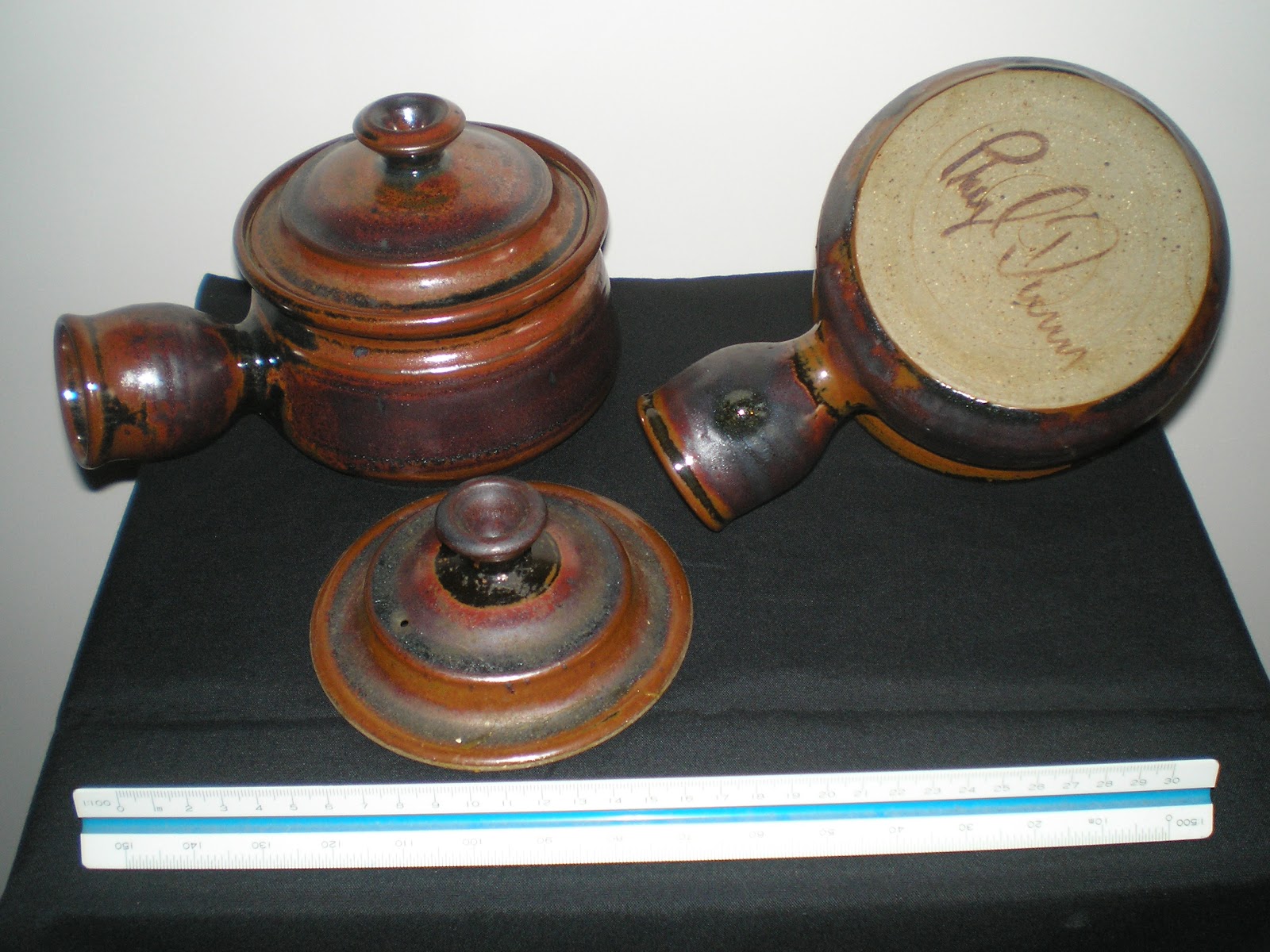
Dunn, Phyl Dunn


Designer        
Phyl Dunn
Maker
Phyl Dunn
Marks
Painted signature “Phyl Dunn” to base
Material
Clay
Description
Large straight sided, high waisted lidded earthenware ramekin.  Flat footring base with indented rim to fir separate lid.  Satin gloss glaze to interior and exterior.  Unglazed base and unglazed lid-rim.  Large tulip hollowed, open-ended handle. (It looks like the handles might have been made from small goblets.)
Condition
Very good
Number
No number
Production Date
1980s
Width at rim
135mm
Width of lid
125mm
Width at Base
110mm
Depth
80mm
Length (with handle)
195mm
Weight
750gm
Volume
750ml
Acquisition
Chapel Street Bazaar
Rameking Reference Number
PHD 001-002

Phyl Dunn was said to be born in Melbourne in 1915.   She had said that 'The first pottery that I had ever seen was in the Primrose Pottery Shop; it was [Allan] Lowe's, and I would press my nose to the window. I had an idea of having a shop in Carlton, where I would sit at the window with a wheel'. She had seen potter Merric Boyd demonstrating pottery at a school demonstration before the war, and had also seen a film about African women firing pots, deciding then that she would like to make pots too. 

Film of African women making pottery was most likely made in Ghana for the Prince of Wales College in Accra, Ghana when Harry Davis was head of the Art School there.  In 1954-55, she completed two terms of night classes with Dora Billington at the Central School of Arts, London.   Dora Billington (1890 – 1968) was an English teacher of pottery and a studio potter. She was born into a family of potters in Stoke-on-Trent and studied at Hanley School of Art. She worked as a decorator for Bernard Moore, 1912-1915, and then took a diploma in ceramics at the Royal College of Art 1915-1916.

As the ceramics department was in danger of closure because of the war, Dora helped to run it with John Adams (who later ran the Poole Pottery).  On completion of her diploma, Dora became head of department. She continued to design for industry, working with J & G Meakin during the 1920s and 1930s.  She left the Royal College in 1924 to take up full time teaching at the Central School of Arts and Crafts, where she later became head of the pottery department.
 
Back in Australia, Phyl became Reg Preston's assistant.  (Reg Preston (18 March 1917 to 14 June 2000)).  She had visited Reg at Warrandyte while attending painting classes with Danila Ivanovich (Daniel) Vassilieff (1897-1958), painter and sculptor, and began working with an unwilling Reg part-time as his apprentice.  
 
The two married in 1958, the same year they both became founding members of the Potters' Cottage.  Potters Cottage was a co-operative founded in Warrandyte in 1958 for the purpose of advocating the idea of making and selling handmade Australian pottery.   Reg had previously been married to Joan.  Phyl hand-decorated some of Preston's pots as well as making her own range of domestic wares and one-off pieces.
 
The potters produced beautiful, functional studio pottery with attention to shape, decoration and glaze, bringing ancient craft together with the modern. Whilst they shared certain principles in their work, the distinctive style and individuality of each artist is strongly evident. Their shared idealistic belief that modern, handmade pottery could enhance the quality of contemporary life was central to their philosophy.
 
The five founding members from 1958 were Reg Preston, Phyl Dunn, Artec Halpern, Gus McLaren who had worked as a cartoonist for the Melbourne Argus  and Charles Wilton; three additional members from 1961 were Sylvia Halpern, Elsa Ardern and Kate Janeba and the final member was Peter Laycock in 1969. The only founding member who was not a potter was the architect John Hipwell who acted as the group's President.
 
In its heyday, Potters Cottage boasted a successful gallery, ceramics school and restaurant. The gallery exhibited members' work as well as work by ceramic artists from across Australia and held the annual Potters Cottage Prize from 1965-1967 and 1978-1982. Potters School, setup in 1969, fostered the careers of a number of successful Australian ceramicists, whilst many in Warrandyte fondly remember lively nights at Potters Restaurant where jazz greats Graeme Bell, Geoff Kitchen and Dick Tattam regularly performed.
 
 Phyl had an exhibition in the Argus Gallery in 1962, and both she and Reg began exhibiting in Craft Association shows, moving from earthenware to stoneware in 1967. Preston and Dunn saw that these kinds of exhibitions gave them a new opportunity: they could raise the price and get out of the rat-race of cups and saucers, and they could also see and show their work in relation to others. This meant they could make work on a different scale, which probably influenced their  shift to stoneware.
 
During the 1960s Preston and Dunn produced a line under the name “Ceres”, and in 1967 Preston began working in stoneware. Preston is perhaps best known for his work in stoneware, often large pieces with bold, abstract decorations, and his lidded shaped pieces with rich vitreous glazes over-poured or brushed with other metallic glazes.  Preston went on to become an acknowledged master and has pieces in collections such as the Powerhouse and QUT museums. 
 
In 1982 the couple set up a studio at Woolamai on Phillip Island in Victoria, where along with husband Reg, she continued to work until 1987. Also working around this time on Phillip Island, but at the other end at Ventnor were potters Eric Juckert and Charles Wilton.  Her works are signed with a painted 'Phil Dunn' or 'P.D'.  Phyl died in Wonthaggi, Victoria on the 18th of October 1999.

 
Image: Unknown Photographer, Reg Preston and Phyl Dunn, c. 1970. Potters Cottage archives, private collection.

Thanks to Judith at Bemboka for some of this post. 


Friday, August 24, 2012

Campbell, John Campbell


Behind the atomic blast-proof doors; deep inside Rameking Mountain, under tonnes of reinforced concrete, the Ramekin Gnomes toil round the clock to preserve these fast disappearing parts of our history in the secret archives of the Rameking.  The Gnomes are the best of their kind and love their work, but sometimes, very, very rarely, something breaks.  When this happens, these Gnomes take the disaster personally, because every time something breaks, the Ramekin Gnomes cry.  To them a ramekin is like one of their children, to be sheltered, nursed and nurtured.  Such a disaster happened recently and the Gnomes are still in mourning.  A John Campbell dish fell and was broken.  On the plus side, the Gnomes had photographed it before its demise.

 
Some of the champion team of Ramekin Gnomes under Rameking Mountain
 
Yes, I know that this was not, by my definition, a ramekin but where do you get a John Campbell bowl for five bucks these days.  It may have had a chip and a crack to one side but it was still a Campbell.  I would love to get some real Campbell ramekins but alas, they may be beyond the means or, so far, the abilities of the Rameking.  I was in Tasmania back in 2010 and despite searching, I found none; so if you have any, and are contemplating selling, please let me know and send me a price.


John Campbell was born on the 11th of November 1857 in Aukland New Zealand to John and Anne (McLean).  The family moved to Bendigo when John was ten years of age and at the age of twelve he became an apprentice at the Bendigo Pottery.

The Bendigo Pottery was started by George Duncan Guthrie, a Scot who was an apprentice potter by the age of 12. He travelled to Australia in 1849 and while visiting his father who was living in Bendigo, noticed the fine white clay of the district. Guthrie transformed this lucky find into a business that grew to rival the great Staffordshire potteries of nineteenth century England.

At Bendigo pottery, John’s newly learned potters skills were rewarded by winning medals in the 1879-80 Melbourne Juvenile Intercolonial Exhibition for his exhibits - a stoneware fountain, a whisky still worm and two terracotta fire grate backs.
In 1880 he moved to Tasmania and in 1881 went into partnership with his future father in law, William Brown Jory in the firm Jory & Campbell Steam Brick Works at Glen Dhu, in the Sandhill area of Launceston near theMc Hugh pottery.  His purchase of approximately 18 acres was formerly Alfred Cornwell's Pottery at 89 Wellington Road and they changed the name to Victorian and Tasmanian Pottery and Pipe Works.  Today, the address is a car parts store.  In the 1891-2 Tasmanian Exhibition in their home town of Launceston, Campbell’s exhibited a range of pots and urns, vases, teapots, cheese dishes with covers, jars, bottles and Toby jugs.


John married Mary Jane Jory on the 9th of April 1884 at her family home “Kings Meadow” in Launceston, Tasmania.  They had eight children; Colin, who took over the firm after his fathers’ death in 1928; Alfred, Rupert, Florence; Rose, Eva and Arthur.  After Colin’s death in 1956 the business continued.  Campbell's Pottery remained in the family until it closed in 1959.  The pipe and brick manufacturing business closed in 1976.

In 1902 Campbell’s pottery became the first industry in Tasmania to use electricity.  They changed their business name from ‘Victorian and Tasmanian Pottery and Pipe Works’ to the undeniably zippier ‘Campbell’s Electric Pottery’. Embracing new technology, however, seems not to have become compulsory at Campbell’s, for as late as 1956 Colin Campbell was still making all the pipe and pottery deliveries in a horse and cart.


Pipe and brick manufacture was the largest part of the Campbell business, but John Campbell's own interest were the hand-thrown decorative items that they manufactured. 
Like McHugh’s, Campbell’s employed workers with experience in potteries on the mainland, such as Bendigo, Bennett’s and Cornwells.  Master craftsman like Denny Beckett were associated with both McHugh’s and Campbell’s.  There is also some evidence of John Campbell having regularly obtained specimens of the high-quality wares being produced at Bendigo Pottery in the mid-1880s from a contact employed there, in order to make moulds from them.

 
Samples

Geoff Ford believes many of the Australian bread plate designs can be traced to the influence of expert mould maker William Holford (1841-1938). Born and trained in England, Holford migrated to New Zealand in 1874 and then Australia in 1876. He worked in a number of potteries in NSW, Victoria and South Australia. His work is characterized by the use of a fern leaf motif, and a particular wheat-sheaf design, while the glazes reflect the characteristics of particular potteries.

Holford can be directly traced to the Alfred Cornwell Pottery in Victoria, and Cornwell originally set up the pottery in Launceston later owned by John Campbell.  There is a strong similarity between some of the bread plates made in these potteries. At a time when potteries made relatively few decorative art-wares, Ford suggests that bread plates provided a way for a mould-maker to demonstrate his skills in design and mould-making, and also a way for a pottery to demonstrate its skills in glazing and firing.
 
In the 1880s Launceston had become the focus of ceramic production, with the Tasmanian market dominated by the potteries of John Campbell (1881–1976) and James McHugh (1879–1961), which manufactured both industrial and finer domestic wares.
 
Although competition among Australian potteries was always very keen, and there are plenty of examples of price-cutting and ‘industrial espionage’ to be found in the record-books, Campbell’s and McHugh’s often worked together cooperatively to share the available work, equipment, and skilled workers to mutual advantage. A great-great granddaughter of John McHugh, Judith Beattie relates that when McHugh was found dead in his pottery works, John Campbell came over and helped keep the business running until the McHugh family could make other arrangements.

Although heavy clay products like pipe and bricks were the mainstay of the business, it was hand-thrown decorative pottery that fascinated John Campbell, who even in his old age spent late nights in his workshop experimenting with shapes and glazes.  The “Drip Glaze” method employed by companies such as McHugh, Campbell and Remeud is in the style of the Arts & Craft movement in Britain. In the UK this style of pottery had mostly died out by the late 1920’s, here in Australia it had a life that went on.  In the case of Remued, until 1956.   Premier Pottery in Melbourne, Victoria (later Remued) was established by David Dee and Reg Hawkins in 1929. Dee, along with his five brothers, was an apprentice at Campbell's pottery where he leant to use the potter's wheel.

John Campbell died in 1929 and the business was taken over by his eldest son, Colin who continued the business. Colin oversaw production of the 1930s art wares, and then later by other family members.  However by the late 1950s, pottery sales were declining due to overseas competition following the 1957 trade agreement with Japan, and input costs such as glazes were increasing and the pottery closed in 1959. 
 
Officially, Campbell’s artware department closed in 1947, although there is a classic ’thirties-style vase signed and dated 1949.  The factory doors closed for the last time in 1976.  Fear not though, because those massive doors of Rameking Mountain are still swinging wide and the Gnomes are ready and willing to accept more offerings for the Rameking.
 
This is what the real ones look like, so if you have any, I would like to take them off your hands for a reasonable price.