Ramekin is thought to come from a Dutch word for "toast" or the German for "little cream."


Name

Ramekin

Variant

Ramequin, Ramekin dish.

Pronounced

(ramə kin)[RAM-ih-kihn]ræməkin

Function

English Noun

Plural

Ramekins

Hypernym

A type of dish

Purpose

Cooking

Etymology

French Ramequin from Low German ramken, diminutive of cream, circa 1706. middle Dutch rammeken (cheese dish) dialect variant of rom (cream), similar to old English ream and German rahm. Ancient French cookbooks refer to ramekins as being garnished fried bread.


Meaning

1. A food mixture, (casserole) specifically a preparation of cheese, especially with breadcrumbs and/or eggs or unsweetened pastry baked on a mould or shell.

2. With a typical volume of 50-250 ml (2-8 oz), it is a small fireproof glass or earthenware individual dish similar in size and shape to a cup, or mould used for cooking or baking and serving sweet or savoury foods.

3. Formerly the name given to toasted cheese; now tarts filled with cream cheese.

4. A young child usually between the ages of 3 months and 11 years exhibiting a compulsion to force or "ram" their head into various objects and structures.

These days, a ramekin is generally regarded as a small single serve heatproof serving bowl used in the preparation or serving of various food dishes, designed to be put into hot ovens and to withstand high temperatures. They were originally made of ceramics but have also been made of glass or porcelain, commonly in a round shape with an angled exterior ridged surface. Ramekins have more lately been standardized to a size with a typical volume of 50-250 ml (2-8 ounce) and are now used for serving a variety of sweet and savoury foods, both entrée and desert.

They are also an attractive addition to the table for serving nuts,dips and other snacks. Because they are designed to hold a serving for just one person, they are usually sold in sets of four, six, or eight. Ramekins now are solid white, round, with a fluted texture covering the outside, and a small lip. Please bear in mind that whatever you ask for them on Internet auction sites, someone is still getting the same thing in an op shop for peanuts.

However, there are hundreds of decorative ramekins that came in a variety of shapes and sizes. They came in countless colours and finishes and many were made by our leading artists and ceramicists. My collection has ramekins with One handle only, fixed to the body at one point only. If it has no handle, it is a bowl. If it has two, it is a casserole dish. But the glory day of the Australian Studio Art ramekin is well and truly over. See some here, ask questions or leave answers.

P.S. Remember, just as real men don't eat quiche, real ramekins don't have lids or two handles. Also remember, two handles makes it a casserole dish. Also, please note If it aint got a handle, it's just a bowl.

P.P.S. To all you cretins who advertise your ramekins by associating them with "Eames" or "Eames Era". Get your hand off it, you are not kidding anyone. The Eames people have told me that they never made ramekins.

P.P.P.s To all the illiterates out there in cyberspace, just as there is no "I" in team, there is no "G" in Ramekin. I am the Rameking, they are ramekins.

If you have a set of Grandma's ramekins at the back of a kitchen cupboard, have a look through the site, maybe you will identify them. Thank-you for looking.

There are many of you out there that have knowledge of Australian pottery. Please let me know if you have anything that I can add to the notes. It is important to get the information recorded. You probably know something that nobody else does.

Please note that while your comments are most welcome, any that contain a link to another site will no longer be published.

-


Tuesday, March 29, 2011

The Primrose Pottery Shop


An important link in the chain of the ramekin story in Melbourne Victoria is that of the Primrose Pottery Shop. It was in business from 1929 through to the mid 1970s. Not to be confused with Primrose, a middle period pattern introduced by Roseville Pottery in 1936, the Primrose Pottery Shop was started at 374 Little Collins Street Melbourne by Edith and Betty Mc Millan in 1929. It is a misnomer to only call it a pottery shop as it also exhibited a range of pottery, ceramics, domestic wares, textile and other artistic works.
It was a centre for artists in Melbourne for a long time. Phyllis Dunn (1915-1999 who helped found the Warrandyte Potters Cottage, once said “The first pottery that I had ever seen was in the Primrose Pottery Shop; it was [Allan] Lowe's, and I would press my nose to the window.” Other people were textile artists John Rodrigues, Michael O'Connell and Ailsa Graham, artist Elizabeth Durack and Stacha Halpern. Stacha was also a potter but moved back to Europe in the early 1960s.
The Primrose Pottery Shop was originally upstairs on the fifth floor above the well-known cafe "The Wattle", at 374 Little Collins Street before moving into the ground floor of a building on the corner of Little Collins and Howie Place, (365-367 Little Collins St) behind what was formerly James McEwan and Sons (McEwans) hardware on Little Collins Street. Edith MacMillan also commissioned items to display for sale in her shop. Some of them were domestic wares the potteries produced for her. She could afford to carry their stock where other stores relied on higher turnover. Being supportive of these crafts people, quality was not a primary concern.
As mentioned above, a number of well-known art potters sold their works through the shop. They also provided an outlet for some of the many struggling post-war European migrant potters. Often it was only Primrose, and surprisingly, the upmarket “Georges” store in Melbourne, that sold their output. Sometimes the larger “Myer” store would also sell them, but usually required a higher volume for their stores. It was a familiar sight to see these couples and their sample cases doing the rounds of the many department stores that then existed throughout the city. That is why it is rare to find any of these makers advertised anywhere.

Wednesday, March 23, 2011

Frank Rock


Designer
Frank Rock
Maker
Frank Rock
Marks
Signature F Rock intaglio painted to centre of base.
Description
Ramekin bowl with body the shape of a Flounder. Heavy earthenware with harlequin glaze to bowl interior and light brushed pale brown colour on exterior under a clear glaze.
Condition
Good, slight chipping to interior of rim.
Number
Production Date
Early 1950s
Width
140mm
Depth
25mm
Length (with handle)
188mm
Weight
285gm
Volume
200ml
Acquisition
Adelaide Antique Market

Born in Java around 1889, a Dutch possession at the time, Franciscus Theodorus Hendrikus (Frank) Rock was in his early 50s when he came to Australia  during the upheaval of the second world war.  He later became a naturalised British Subject.  Ford tells us that Rock was a retired Dutch ceramic engineer who set up a studio in Balmoral, Sydney in 1950 and continued working there until the late 1950s, making a small range of slipcast functional ware, using brilliant glazes and foliage decoration reminiscent of Javanese art.  Frank lived and worked in Stancliff Flats at 6 Wyargine Street Mosman.  He moved there in 1943 and was actually a Mechanical Engineer.  His home backed onto the beach at Edwards Bay and are now a block of flats overlooking Balmoral Beach on the shore of Sydney Harbour.  An early example of what are now called Home Units, the property originally belonged to retired Doctor Mary Rocke, I don’t know if she was a relative.  The original “Frank Rock” moulds for these fish ramekins were still at the Easton Pottery in Willoughby, Sydney, when Jan Gluck began renting it in 1958. Frank lived in Balmoral. Henrietta Easton had stopped working at 495 Willoughby Road in Willoughby in 1956. Jan produced ramekins with almost identical glazing to Frank, except his had a hole in the tail.  Fish-shaped ramekins must have been one of his most popular lines, given how many are still around. These are 3 cm high, 19.5 cm long and 14 cm wide. Frank Rock died in Mosman in 1959 aged 70 years. 
This comment is partially copied from Australian Pottery Blogs.

Friday, March 11, 2011

Recipes


There have been a couple of people on the net who have been inspired by my blog to cook using their ramekins. This is great to hear because that is what they were made for. To help you along, I have trawled the newspaper archives in Australia to bring you a selection of recipes for ramekins from early to late 20th century. Please try them, there is something for everyone. There are breakfast ideas, even something for the vegetarians. Fish and meat are represented as are deserts, known at the time in Australia as “Sweets.” There is even a recipe for those old singles favourites, fish fingers.


Saturday, February 19, 2011

Guy Boyd / Martin Boyd


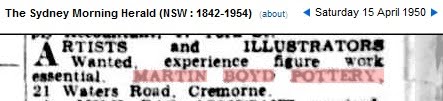
Guy Martin a'Beckett Boyd, born at Murrumbeena in 1923 (12 June 1923 – 26 April 1988) was the second son of Merric and Doris Boyd. Guy Boyd's first business venture was a very successful commercial pottery studio. One of the main products was ramekins. You see them everywhere. Most are in matching reverse colours. Just because they are signed "Guy Boyd", people think they are collectable. In the future they probably will be but now they are a dime a dozen. You can usually find at least one in every antique shop. They seem to breed as fast as old metal coat hangers. If there isn't one there today, there will be tomorrow. Legally, they are "Boyd", but remember that it is unlikely that any member of the Boyd family were within several hundred miles of them when they were made. The pale ones at the top (which are genuine Guy Boyd from his Melbourne studio in the mid sixties) have sgraffito (incised) along the sides before glazing, a popular design. They were sold in sets along with the soup tureen. They are 120mm wide and 45 mm deep plus 30mm for the handle. Sadly, the tureens don't survive, but the ramekins do. In the late 1950s, Guy had his works at Crosbie Park Avenue in East Bentleigh After his return from Sydney, Guy opened a shop at 247 Bridge Road Richmond. In the mid 1960s he operated from the Ray Cook premises in Carey Street, East Bentleigh. The similarity of the Boyd and Cook ramekins makes me wonder who influenced who at this time. These have no chips cracks or crazing and have a matt monocolour glaze. In 1965, Guy gave up pottery for a full-time career as a sculptor, and began exhibiting at the Australian galleries. Guy Boyd married Phyllis Nairn with whom he had seven children, some of whom have also gone on to become sculptors, writers and artists. He died in 1988. Please be aware when you see the name on the base. In 1946, while Guy was studying at the East Sydney Technical College, he worked at night with Norma Flegg in her basement pottery in Cremorne. They originally used the name “Guy Boyd” incised on the base, but in 1948, they began using the name “Martin Boyd” after Norma’s husband Leonard joined the company. Guy returned to Victoria in 1950 and the company in Sydney continued to use the name until it ceased production in 1964. His Melbourne pottery operated from 1952.) The Sydney pottery developed their own high quality glazes and at its height, employed up to eighty people. They also used a variety of other names as they produced pottery for department stores and commemorative wares.


Arthur Boyd / John Perceval

Arthur Boyd and John Perceval at work at "Open Country" 1945 Photo Copyright Commonwealth Government


Designer
Arthur Boyd
Maker
John Perceval
Marks
Incised AMB to base
Description
Banded scored slipware, pink exterior and green interior. Solid stem handle with pinched end. Green colour to pinched end.
Condition
Good condition with slight overcooking to interior glaze. There is slight exterior crazing consistent with age.
Number
Production Date
Late 1940s, early 1950s
Width
93mm
Depth
57mm
Length (with handle)
140mm
Weight
145gm
Volume
250ml
Acquisition
Mordialloc Antiques
There is so much information available today about the Boyd family and their artistic legacy that I won't repeat too much here. These three AMB (Arthur Merric Boyd) ramekins are crudely glazed and made like much of their output. Their apperance shows them to most likely be very early examples of the work of Arthur Boyd and John Perceval. They are glazed in classic John Perceval colours of green and pink. The hand made stem handles with pinched ends are, as usual roughly made. The glaze interior is patchy and the exterior is scored, but this is how Boyd and Perceval made and sold their earliest work. There is slight exterior crazing consistent with age.
Merric Boyd, sometimes described as the father of art pottery in Australia, having held the first exhibition of his work in Melbourne in 1912. He had his pots fired in Hoffman Pottery kilns from1926 after he burned out his own. He is also thought to have modelled some decorations for use in the Mel-rose line.
The Boyd’s are probably Australia's most famous and prolific artistic family over several generations.The pottery named "Open Country"was located at the corner of Wahroonga and Weeroona Roads Murrumbeena and the output sold through their shop at 500 Neerim Road, Murrumbeena, just a short walk from "Open Country". If you go looking for the spot, it is now a pile of cream brick 1960s flats. The Boyd home was at 3-5 Calloola Avenue, Oakleigh after they sold the pottery following Arthur's death. Eventually, a lot of the pottery was made at Neerim Road.
Probably the best known was Arthur Merric Bloomfield Boyd (1920-1999), painter, and potter who married Yvonne Lennie, painter, one of their children was Guy Martin a Beckett Boyd (1923-1988), also later famous as a sculptor, he married Phyllis Emma Nairn.
John de Burgh Perceval 1923-2000. Better known as one of Australia's leading painters,Perceval enlisted in the army in 1941 where he met Arthur Boyd and after his discharge he moved into the Boyd family home. He married Arthur’s younger sister Mary in 1944 and with others helped to establish “Arthur Merric Boyd (AMB) Pottery”. Sadly, his later life was marred by health problems.

The following is edited from the Australian Pottery Blogs.
Painting and pottery was closely intertwined in the Boyd family. Doris was a talented painter and decorated some of her husband’s pots. Their children learnt to make and decorate pottery at their parents’ knees and were able to use this skill as a way of making a living while they explored other areas of interest such as painting and sculpture. They married other artists and drew them into the family tradition. The second-world war interrupted their lives but also led them to new artistic associations.
Merric’s father Arthur Merric Boyd (1862-1940) was a painter, not a potter, but his name lives on in the Arthur Merric Boyd (AMB) Pottery set up by his grandson Arthur, John Perceval and Peter Herbst at Murrumbeena in 1944. (Actually, they bought Hatton Beck’s pottery when the Becks moved to Brisbane.) Arthur left Australia for England in 1958 and went on to become one of Australia’s most significant painters, but pieces with various AMB marks continued to be made until 1962.
Similarly, Merric’s younger brother Martin (1893-1972) was a writer not a potter, but his name lives on in the Sydney-based Martin Boyd Pottery set up by Guy with partners Norma and Leonard Flegg in 1946. Guy was training as a sculptor at the East Sydney Technical College (ESTC) after the war and needed an interim source of income. He returned to Melbourne in 1951 but the Fleggs continued to operate the Martin Boyd Pottery as a successful venture until slow sales caused in part by overseas imports put it out of business in 1963. Ford (p. 43) records the year of Guy’s return to Melbourne as 1955. In fact, he transferred his interest in the pottery to Leonard’s brother Ronald in 1951. On his return to Melbourne, he set up a new pottery, the Guy Boyd Pottery, in 1952. He and his wife operated this until 1964, when he sold it to devote himself full-time to sculpture.
Guy’s brother David worked with him as a thrower in Sydney in the start-up post-war years. This is where he met Hermia, an art student at ESTC experimenting with decoration at the pottery in her spare time. They lived and worked in Australia, England and France before closing their last pottery in Murrumbeena in 1968 to concentrate on other interests – David on painting and Hermia on etching and sculpture. Their work was marketed as art pottery through exhibitions rather than stores. In 1960 they were guest exhibitors at the Potters’ Cottage in Warrandyte where it was reported that great interest was shown in the new techniques they had developed during their overseas travels and prices ranged as high as fifty guineas.
The majority of e-Bay listings are from the Martin Boyd Pottery that has its own strong following. Ramekins abound and no wonder, because it was the pottery’s most popular production line and nearly a million were made. Ramekins were also a mainstay of the Guy Boyd and AMB Potteries. This form was simple to throw and decorate. The handle also lends aplomb, particularly when incorporated seamlessly into the form and decoration.
Obviously the Army did not form the best impression of Arthur.  I'm glad he didn't let this slow him down later.

Monday, February 14, 2011

Nixon Pottery


Designer
Nixon Pottery, Sydney NSW.
Maker
Nixon Pottery 6a Mable Street Hurstville
Marks
Incised “Nixon” to unglazed base
Description
Heart shaped thin sided slipware bowl with clear gloss overglaze. One piece moulded handle cast as part of bowl.
Decoration
Hand painted marine grasses to exterior sides and handle. Stylized fish painted to interior bottom of bowl. One ramekin has a plain exterior with a light blue interior overpainted with a wildflower motif.
Condition
Good condition. Very well made No chips or cracks. Some crazing consistent with age to overglaze.
Number
Production Date
Width
110mm
Depth
37mm
Length (with handle)
160mm
Weight
140gm
Volume
250ml
Acquisition
These notes were modified from the Powerhouse Museum notes.

These slipware ramekins were made in the 1950s and 1960s by the small company, Nixon Pottery 6a Mabel Street Hurstville, Sydney, New South Wales. It was one of dozens of small potteries operating in Sydney after the Second World War. Its main rival, was the Martin Boyd Pottery, the most significant pottery in Sydney at this time and was responsible for wares decorated with Aboriginal-style motifs. These Nixon ramekins feature similar decorations - hand painted in a stylized manner and probably representing Aboriginal motifs.

While some of these domestic wares were made from thrown clay, many were moulded or slipcast and were usually decorated with mix-and-match colours and painted designs. The most popular forms of domestic ware included coffee sets, ramekin sets, dinner sets, and ashtrays and savoury dishes shaped like boomerangs. With restrictions on imports continuing after the war, these items proved immensely popular in Australia and featured in home-living journals, like 'Australian Home Beautiful'. Arising from this trend was an overseas market for Australian wares. It appears that Nixon, like many other makers, did not need to advertize as it sold direct to stores. It was these stores that advertized as required.

They were made by Dallas Raymond Nixon who operated Nixons Art Productions in the early 1950s.  In 1954, he and his wife Betty incorporated as "Jemba Potteries Pty Ltd", a short lived, ill fated venture that closed after less than a year.

Sylha


These dishes from the early 1950s are not ramekins as are represented by some sellers on internet auction sites. They are what was known as Hors d’Oeuvres dishes and were part of a set of five dishes that nestled in a low-sided wicker basket or a metal frame that rotated in the centre of a table. Expensive for their time, they are relatively uncommon and should be purchased if you see them. They are still an ideal retro addition to any entertainer’s home but should not be called ramekins.


SYLHA was originally three people; Sylvia Halpern, Artek (Artur) Halpern, and Artur’s brother Stanislaw.

Sylvia Pauline Halpern (nee Black), was born in Kobe Japan on the 25th March 1918 and came to Australia in the late 1930s.  Artek (Artur) (1908-1976) arrived in Fremantle Australia aboard the “Asturias” on the 6th March 1947. His brother Stanislaw born Zolichev Poland (1919-1969) having arrived in Fremantle before the war aboard the “Otranto” on the 15th of August 1939.  The brothers were the sons of Eisig Halpern, engineer, and his wife Berta, née Gutt.  Having lost their family property during the Nazi occupation, the Halpern family subsequently filed for compensation along with other family members Leon and Edward Halpern for land in Lvov , then in Poland, now in the Ukraine, taken over by the authorities.  With the fall of the Iron Curtain, I wonder if they got it back?  Artur worked for RCA in South Melbourne for a time.

Sylha stands for Sylvia Halpern, the name given to their output by Artur.  Confusion may arise over Sylvia and Artur.  She was actually married to Stanislaw on the 28th August 1943 in Melbourne, years before Artur arrived.  She and Stanislaw were later divorced after having a daughter who predeceased them.  It was Artur and Sylvia who both made pottery using this brand. The Sylha Ceramics Studio was run by Artur and Sylvia and was originally located in the backyard at 1 Murrumbeena Parade, Murrumbeena before moving to Natalia Avenue, South Oakleigh in 1950 and then to Warrandyte in 1958 where Artur helped to found the Potters Cottage.  In South Oakleigh they employed two Italian potters and working with them, he learnt the skills of mould-making and slip-casting. Artur learned a lot from one of them, Costantino Bacchini (b: 9 September 1921) who arrived in Melbourne in 1952 under the Australian Italian Migration Agreement.  West-Australian potter Mike Kusnik also worked there in 1959. 

Artur had qualified as an Engineer in Czechoslovakia and in 1950, built the electric kiln they used.  Artur and Sylvia later moved to Dingley Dell, Warrandyte and joined the Potters Cottage (in 1961).  Sylvia Pauline Black had studied at RMIT under Klytie Pate and John Barnard Knight in 1944-45, and then later taught Artur and his brother, her former husband Stanislaw. Artur, an engineer built their first kiln (electric) and used Sylha as his brand. Several kilns were later built and in a relatively short time Artur and Sylvia was earning a full time living as potters, although it appears that Sylvia was the major partner with Arthur the marketing person.  Not one to do things by halves, Artur imported great quantities of glaze colours from England and Germany as these were unavailable in Australia at the time.

Like most makers of the day, their sales were made through department stores to whom they sold direct. Artur sold mainly through the Primrose Pottery Shop in Melbourne (see the post for them). Most makers did not advertise, leaving that up to the stores that sold their ramekins.  Sylvia signed hers “Sylvia Halpern”, not to be confused Stanislaw who signed his pieces “shalpern”. The family tradition continues with daughter Deborah also taking up pottery after being “apprenticed” to   Artur.

The five founding members of the Warrandyte Potters Cottage, from 1958 were Reg Preston, Phyllis Dunn, Artur Halpern, Gus McLaren and Charles Wilton; three other members joining in 1961 were Sylvia Halpern, Elsa Ardern and Kate Janeba. The only founding member who was not a potter was the architect John Hipwell who acted as the group's President. 

Potters Cottage was officially opened in 1958 by Dame Mabel Brookes, wife of the Governor of Victoria, Sir Dallas Brookes.  It was a small miner’s cottage in Research Road near the Warrandyte Bridge. It was then known as “Moonlight Cottage”, because the gold miner who built it in the 1890s worked in the Caledonia Gold Mine by day, and built his cottage by moonlight. By 1969 the Potters Cottage Co-op had built a restaurant where people were able to have their meals served on and in the pottery that was made by local craftspeople.

The co-operative was established for the purpose of making and selling handmade Australian pottery. The potters produced beautiful, functional studio pottery with attention to shape, decoration and glaze, bringing traditional craft together with modern. Whilst they shared certain principles in their work, the distinctive style and individuality of each artist is strongly evident. Their shared idealistic belief that modern, handmade pottery could enhance the quality of contemporary life was central to their philosophy.  The Co-op built a pottery school where people could learn to make their own pottery.

A group of students from this pottery school went on to form their own co-op, Stonehouse Potters in 1972, which is still flourishing. As well as the significant numbers of potters in the region, the Pottery Expo in Warrandyte each autumn highlights this important artistic tradition.

Stanislaw deserves his own story, but not here because he didn’t make ramekins.  Look him up, he is one of the great underrated artists of Australia.